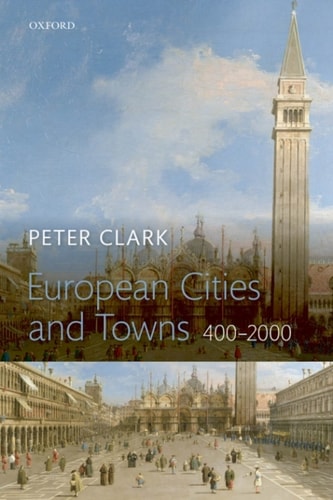
European Cities and Towns: 400-2000
0
0
As an Amazon Associate and affiliate partner, Menrva Books earns from qualifying purchases. Learn more
Author Description
Since the Middle Ages Europe has been one of the most urbanized continents on the planet and Europe's cities have firmly stamped their imprint on the continent's economic, social, political, and cultural life. This study of European cities and towns from the fall of the Roman Empire to the present day looks both at regional trends from across Europe and also at the widely differing fortunes of individual communities on the roller coaster of European urbanization. Taking a wide-angled view of the continent that embraces northern and eastern Europe as well as the city systems of the Mediterranean and western Europe, it addresses important debates ranging from the nature of urban survival in the post-Roman era to the position of the European city in a globalizing world. The book is divided into three parts, dealing with the middle ages, the early modern period, and the nineteenth and twentieth centuries - with each part containing chapters on urban trends, the urban economy, social developments, cultural life and landscape, and governance. Throughout, the book addresses key questions such as the role of migration, including that of women and ethnic minorities; the functioning of competition and emulation between cities, as well as issues of inter-urban cooperation; the different ways civic leaders have sought to promote urban identity and visibility; the significance of urban autonomy in enabling cities to protect their interests against the state; and not least why European cities and towns over the period have been such pressure cookers for new ideas and creativity, whether economic, political, or cultural.
Menrva's Summary
THE THESIS
This study investigates the historical evolution of European urban centers from the post-Roman era to the present, examining how cities shaped the economic, social, and political trajectory of the continent. Peter B. Clark, a specialist in urban history, synthesizes regional trends and individual city trajectories to explain the persistence and transformation of urban life. The work utilizes a comparative framework to analyze how cities functioned as hubs of innovation, governance, and cultural identity across fifteen centuries.
THE SCOPE MAP
What You Will Find
- Analysis of urban development across Northern, Eastern, Mediterranean, and Western Europe.
- Examination of urban economies, social structures, cultural landscapes, and governance models.
- Investigation into the roles of migration, gender, and ethnic minorities in city life.
- Discussion of inter-urban competition, cooperation, and the pursuit of civic autonomy.
Scope Limits
- The text focuses primarily on the macro-level trends of urbanization rather than exhaustive micro-histories of every individual town.
- It does not provide a comprehensive architectural survey of every European city mentioned.
THE AUTHORITY PERSPECTIVE
Scholars and students of urban history recognize this work as a comprehensive synthesis of long-term European urbanization patterns. Readers frequently note the academic density of the prose and the breadth of the comparative analysis provided by the author.
Page Count:
432
Publication Date:
2009-01-01
Publisher:
Oxford University Press
ISBN-10:
0191547441
ISBN-13:
9780191547447
Economics
History
Cultural History
Cities And Towns
European History
Urban Studies
Sociology
Community Tags
Similar Books