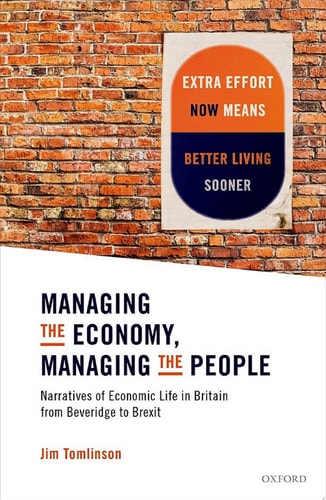
Managing the Economy, Managing the People: Narratives of Economic Life in Britain from Beveridge to Brexit
0
0
As an Amazon Associate and affiliate partner, Menrva Books earns from qualifying purchases. Learn more
Author Description
This study offers a distinctive new account of British economic life since the Second World War, focussing upon the ways in which successive governments, in seeking to manage the economy, have sought simultaneously to 'manage the people': to try and manage popular understanding of economic issues. In doing so, governments have sought not only to shape expectations for electoral purposes but to construct broader narratives about how 'the economy' should be understood. The starting point of this work is to ask why these goals have been focussed upon (and differentially over time), how they have been constructed to appeal to the population, and, insofar as this can be assessed, how far the population has accepted these narratives. The first half of the book analyses the development of the major narratives from the 1940s onwards, addressing the notion of 'austerity' and its particular meaning in the 1940s; the rise of a narrative of 'economic decline from the late 1950s, and the subsequent attempts to 'modernize' the economy; the attempts to 'roll back the state' from the 1970s; the impact of ideas of 'globalization' in the 1900s; and, finally, the way the crisis of 2008/9 onwards was constructed as a problem of 'debts and deficits'. The second part of the book focuses on four key issues in attempts to 'manage the people': productivity, the balance of payments, inflation, and unemployment. It shows how, in each case, governments sought to get the populace to understand these issues in a particular light, and shaped strategies to that end.
Menrva's Summary
THE THESIS
This book investigates how British governments from the post-war era to the present have attempted to manage public perception and understanding of the economy to achieve political and policy objectives. Jim Tomlinson, a professor of economic and social history, utilizes a historical framework to analyze the construction of economic narratives. He argues that state-led efforts to shape public expectations regarding economic performance are central to understanding the evolution of British governance and political discourse.
THE SCOPE MAP
What You Will Find
- A chronological analysis of economic narratives including austerity, decline, modernization, and globalization.
- An examination of four specific economic indicators: productivity, balance of payments, inflation, and unemployment.
- A study of the interplay between government rhetoric and public reception of economic policy.
Scope Limits
- The book does not provide a comprehensive technical history of British economic policy or macroeconomic data sets.
- It does not focus on the private sector or corporate economic management outside of government influence.
THE AUTHORITY PERSPECTIVE
Scholars and historians recognize this work as a significant contribution to the study of political communication and economic history in Britain. Readers frequently note the academic density of the prose and the author's meticulous approach to tracing the evolution of state-sponsored economic narratives.
Page Count:
287
Publication Date:
2017-01-01
Publisher:
OUP Oxford
ISBN-10:
019108929X
ISBN-13:
9780191089299
Economics
History
20th Century
European History
British History
Community Tags
Similar Books