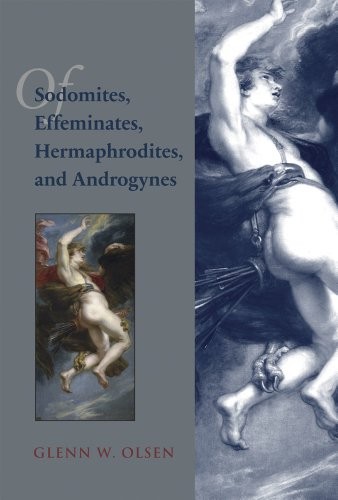
Of Sodomites, Effeminates, Hermaphrodytes, and Androgynes
0
0
As an Amazon Associate and affiliate partner, Menrva Books earns from qualifying purchases. Learn more
Author Description
This book examines the history of sex and gender from a linguistic, artistic, and philosophical perspective, providing a new paradigm with which to analyze this controversial subject. Glenn Olsen's wide-ranging scholarship and his attention to primary sources and contemporary interpretations are enhanced by the inclusion of numerous illustrations of Romanesque sculpture. Part one takes the reader on a journey from the ancient worlds through the early middle ages, examining literature, art, and sculpture in order to capture the 'sexual imagination' of the period. Olsen emphasizes that all centuries had a varied languages of sex, focusing on the means by which "sex" was put into words, especially in penitentials and canon law. He shows there was no single understanding of gender and power relationships, arguing that the story of gender should encompass more than the history of power. Part two turns to Peter Damian, especially his Epistle 31, the so-called Book of Gomorrah. Olsen explores the themes of nature, sin and demonic incitement, lust, free will and effeminacy, as well as the question of whether Damian represented the onset of the persecuting society'--Publisher's website.
Menrva's Summary
THE THESIS
This book investigates the historical construction of sex and gender through linguistic, artistic, and philosophical lenses, proposing a novel framework for analyzing these contested concepts. Glenn Olsen, drawing on extensive scholarship and primary sources, examines the 'sexual imagination' of various historical periods, from antiquity through the early Middle Ages. He highlights the diverse vocabularies used to describe sex and gender, particularly within legal and religious texts, and argues against a singular narrative of power. The work further scrutinizes Peter Damian's influential Epistle 31, exploring themes of nature, sin, free will, and the emergence of a persecuting society.
THE SCOPE MAP
- Analysis of sex and gender from linguistic, artistic, and philosophical perspectives.
- Exploration of the 'sexual imagination' across historical periods, from ancient worlds to the early Middle Ages.
- Focus on the language of sex and gender in primary sources, including penitentials and canon law.
- Argument for a multi-faceted understanding of gender and power relationships, moving beyond solely historical power dynamics.
- Detailed examination of Peter Damian's Epistle 31, also known as the Book of Gomorrah.
- Discussion of themes such as nature, sin, demonic incitement, lust, free will, and effeminacy.
- Inclusion of numerous illustrations of Romanesque sculpture to complement the textual analysis.
- Consideration of whether Damian's work signaled the beginning of a 'persecuting society'.
THE AUTHORITY PERSPECTIVE
This scholarly work is positioned as a significant contribution to the history of sex and gender, offering a new analytical paradigm. Its strength lies in Olsen's deep engagement with primary sources and diverse artistic evidence, particularly Romanesque sculpture. The book aims to provide a nuanced understanding of historical concepts of sex and gender, challenging simplistic interpretations and emphasizing the complexity of language and belief systems across different eras.
Page Count:
523
Publication Date:
2011-01-01
ISBN-10:
0888441762
ISBN-13:
9780888441768
Philosophy
Non-Fiction
History
Religion
Linguistics
Gender Studies
Art History
Community Tags
Similar Books