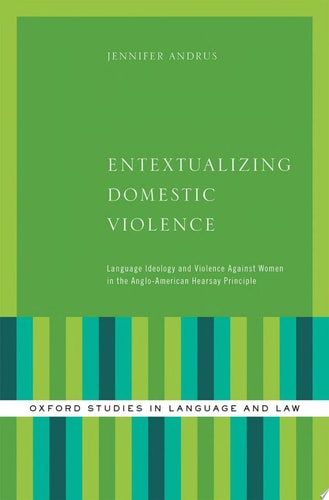
Entextualizing Domestic Violence: Language Ideology and Violence Against Women in the Anglo-American Hearsay Principle
0
0
As an Amazon Associate and affiliate partner, Menrva Books earns from qualifying purchases. Learn more
Author Description
Language Ideology Is A Concept Developed In Linguistic Anthropology To Explain The Ways In Which Ideas About The Definition And Functions Of Language Can Become Linked With Social Discourses And Identities. In Entextualizing Domestic Violence, Jennifer Andrus Demonstrates How Language Ideologies That Are Circulated In The Anglo-american Law Of Evidence Draw On And Create Indexical Links To Social Discourses, Affecting Speakers Whose Utterances Are Used As Evidence In Legal Situations. Andrus Addresses More Specifically The Tendency Of Such A Language Ideology To Create The Potential To Speak For, Appropriate, And Ignore The Speech Of Women Who Have Been Victims Of Domestic Violence. In Addition To Identifying Specific Linguistic Strategies Employed In Legal Situations, She Analyzes Assumptions About Language Circulated And Animated In The Legal Text And Talk Used To Evaluate Spoken Evidence, And Describes The Consequences Of The Language Ideology When It Is Co-articulated With Discourses About Gender And Domestic Violence. The Book Focuses On The Pair Of Rules Concerning Hearsay And Its Exceptions In The Anglo-american Law Of Evidence. Andrus Considers Legal Discourses, Including Statutes, Precedents, Their Application In Trials, And The Relationship Between Such Legal Discourses And Social Discourses About Domestic Violence. Using Discourse Analysis, She Demonstrates The Ways Legal Metadiscourses About Hearsay Are Articulated With Social Discourses About Domestic Violence, And The Impact Of This Powerful Co-articulation On The Individual Whose Speech Is Legally Appropriated. Andrus Approaches Legal Rules And Language Ideology Both Diachronically And Synchronically In This Book, Which Will Be An Important Addition To Ongoing Research And Discussion On The Role Legal Appropriation Of Speech May Have In Perpetuating The Voicelessness Of Victims In The Legal Treatment Of Domestic Violence.
Menrva's Summary
THE THESIS
This book investigates how language ideologies embedded within the Anglo-American hearsay principle systematically influence the legal treatment and representation of domestic violence victims. Jennifer Andrus, a scholar in linguistics and legal discourse, utilizes a framework of linguistic anthropology to examine how legal metadiscourses intersect with social perceptions of gender. By analyzing statutes, precedents, and trial transcripts, she argues that these linguistic structures often appropriate or silence the testimony of victims, thereby reinforcing existing power imbalances in the courtroom.
THE SCOPE MAP
What You Will Find
- Analysis of the hearsay rule and its exceptions within Anglo-American law.
- Application of discourse analysis to legal texts and courtroom talk.
- Examination of the co-articulation between legal metadiscourse and social discourses regarding domestic violence.
Scope Limits
- The study focuses primarily on the Anglo-American legal tradition and does not provide a comparative analysis of civil law systems.
- The research does not offer a comprehensive history of domestic violence legislation, focusing instead on the specific linguistic mechanisms of evidence evaluation.
THE AUTHORITY PERSPECTIVE
Scholars in the fields of legal linguistics and sociology recognize this work as a rigorous examination of how courtroom procedures shape the agency of victims. Readers frequently note the academic density of the prose, which is intended for an audience familiar with discourse analysis and legal theory.
Page Count:
304
Publication Date:
2014-01-01
Publisher:
Oxford University Press, Incorporated
ISBN-10:
019022584X
ISBN-13:
9780190225841
Law
Sociology
Linguistics
Hearsay Evidence
Legal Anthropology
Gender Studies
Community Tags
Other Editions(2)
Similar Books





Reader Comments
Share Your Thoughts
No comments yet. Be the first to share your thoughts!