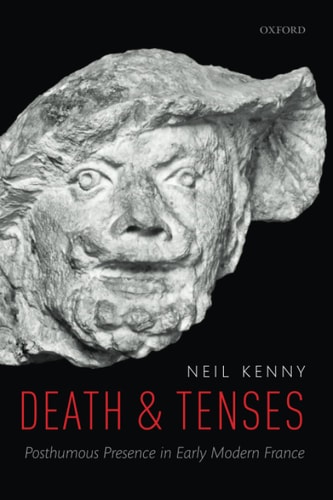
Death and Tenses: Posthumous Presence in Early Modern France
0
0
As an Amazon Associate and affiliate partner, Menrva Books earns from qualifying purchases. Learn more
Author Description
In what tense should we refer to the dead? The question has long been asked, from Cicero to Julian Barnes. Answering it is partly a matter of grammar and stylistic convention. But the hesitation, annoyance, and even distress that can be caused by the "wrong" tense suggests that more may be at stake--our very relation to the dead. This book, the first to test that hypothesis, investigates how tenses were used in sixteenth and early seventeenth-century France (especially in French but also in Latin) to refer to dead friends, lovers, family members, enemies, colleagues, writers, officials, kings and queens of recent times, and also to those who had died long before, whether Christ, the saints, or the ancient Greeks and Romans who posthumously filled the minds of Renaissance humanists. Did tenses refer to the dead in ways that contributed to granting them differing degrees of presence (and absence)? Did tenses communicate dimensions of posthumous presence (and absence) that partly eluded more concept-based affirmations? The investigation ranges from funerary and devotional writing to Eucharistic theology, from poetry to humanist paratexts, from Rabelais's prose fiction to Montaigne's Essais. Primarily a work of literary and cultural history, it also draws on early modern grammatical thought and on modern linguistics (with its concept of aspect and its questioning of "tense"), while arguing that neither can fully explain the phenomena studied. The book briefly compares early modern usage with tendencies in modern French and English in the West, asking whether changes in belief about posthumous survival have been accompanied by changes in tense-use.
Menrva's Summary
THE THESIS
This book investigates the linguistic and cultural mechanisms by which early modern French writers used grammatical tenses to negotiate the presence and absence of the deceased. The author, Kenny, examines how the selection of specific tenses in sixteenth and seventeenth-century texts—ranging from funerary inscriptions to philosophical essays—reflects shifting attitudes toward posthumous survival. By integrating historical analysis with modern linguistic theory, the work argues that grammatical choices serve as a primary site for expressing the complex, often elusive relationship between the living and the dead.
THE SCOPE MAP
What You Will Find
- An analysis of grammatical tense usage in sixteenth and seventeenth-century French and Latin texts.
- A comparative study of funerary writing, devotional literature, Eucharistic theology, and humanist paratexts.
- A critical evaluation of early modern grammatical thought alongside contemporary linguistic concepts of aspect.
- A comparative assessment of early modern linguistic habits versus modern Western conventions regarding posthumous reference.
THE AUTHORITY PERSPECTIVE
Scholars recognize this work as a specialized contribution to the intersection of historical linguistics and cultural history. Readers frequently note the academic density of the prose, which demands a high level of familiarity with both early modern French literature and linguistic theory.
Page Count:
304
Publication Date:
2020-10-10
Publisher:
Oxford University Press
ISBN-10:
0198831153
ISBN-13:
9780198831150
Philosophy
History
In literature
French literature
Literary Criticism
Linguistics
Community Tags
Similar Books