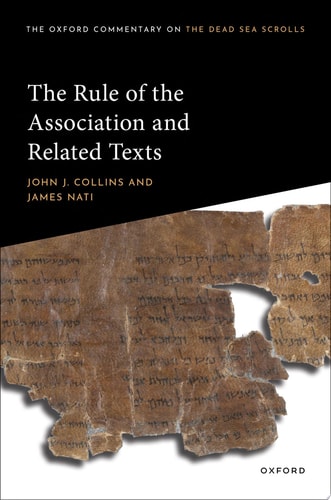
The Rule of the Association and Related Texts: Oxford Commentary on the Dead Sea Scrolls
0
0
As an Amazon Associate and affiliate partner, Menrva Books earns from qualifying purchases. Learn more
Author Description
The Rule of the Association (1QS; Serek ha-Yahad) is the primary description of the sectarian community described in the Dead Sea Scrolls. It was one of the first Scrolls published, in 1951. Several related fragmentary scrolls subsequently came to light. This book provides text, translation, and commentary on all these manuscripts, with a substantial introduction that locates the Rule in the context of the sectarian movement.Distinctive features of this commentary include: presentation of the Hebrew text; treatment of the related manuscripts as texts in their own right, not just as stages in the development of 1QS; recognition that this was a rule for a movement with many settlements and not just for the community that lived at Qumran; recognition of graded levels of holiness within 1QS; recognition of conceptual differences between 1QS and some of the related fragments with regard to the nature and goals of the association; discussion of the broader cultural context of voluntary associations in the Hellenistic world, and the influence of Persian dualism on the Instruction on the Two Spirits in 1QS 3-4.The commentary also engages the full range of scholarship on the texts known as 1QSa (The Rule of the Community) and 1QSb (The Scroll of Blessings) which were copied on the same scroll as 1QS but appear to have originated separately.
Menrva's Summary
THE THESIS
This volume investigates the foundational sectarian identity and organizational structure of the community responsible for the Dead Sea Scrolls through a comprehensive analysis of the Rule of the Association. Authors James Nati and John J. Collins utilize a rigorous philological and historical framework to examine the primary manuscript (1QS) alongside related fragmentary texts. By situating these documents within the broader Hellenistic cultural landscape and Persian dualistic traditions, the authors argue for a more nuanced understanding of the movement's decentralized nature and internal hierarchy. The work synthesizes decades of scholarship to provide a definitive interpretation of the community's rules and theological goals.
THE SCOPE MAP
What You Will Find
- Critical editions of the Hebrew text and English translations of the Rule of the Association and related fragments.
- Analysis of the sectarian movement's organizational structure across multiple settlements rather than a single location.
- Examination of the influence of Persian dualism on the Instruction on the Two Spirits.
- Comparative study of 1QSa and 1QSb in relation to the primary Rule of the Community.
THE AUTHORITY PERSPECTIVE
Scholars and students of Qumran studies frequently cite this volume as a foundational resource for its meticulous treatment of fragmentary manuscripts as independent texts. Experts highlight the authors' ability to balance complex linguistic analysis with broader historical context, making it a standard reference for academic research.
Page Count:
320
Publication Date:
2024-09-20
Publisher:
Oxford University Press
ISBN-10:
019884574X
ISBN-13:
9780198845744
Religion
History
Additional Texts
Archaeology
Bible Study
Judaism
Ancient History
Commentaries
Community Tags
Similar Books