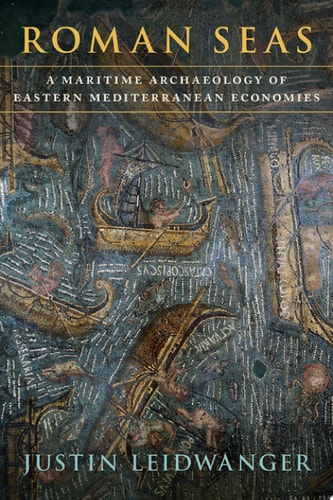
Roman Seas: A Maritime Archaeology of Eastern Mediterranean Economies
0
0
As an Amazon Associate and affiliate partner, Menrva Books earns from qualifying purchases. Learn more
Author Description
That seafaring was fundamental to Roman prosperity in the eastern Mediterranean is beyond doubt, but a tendency by scholars to focus on the grandest long-distance movements between major cities has obscured the finer and varied contours of maritime interaction. This book offers a nuanced archaeological analysis of maritime economy and connectivity in the Roman east. Drawing together maritime landscape studies and network analysis, Roman Seas takes a bottom-up view of the diverse socioeconomic conditions and seafaring logistics that generated multiple structures and scales of interaction. The material record of shipwrecks and ports along a vital corridor from the southeast Aegean across the northeast Mediterranean provides a case study of regional exchange and communication based on routine sails between simple coastal harbors. Rather than a single well-integrated and persistent Mediterranean network, multiple discrete and evolving regional and interregional systems emerge. This analysis sheds light on the cadence of economic life along the coast, the development of market institutions, and the regional continuities that underpinned integration-despite imperial fragmentation-between the second century BCE and the seventh century CE. Roman Seas advances a new approach to the synthesis of shipwreck and other maritime archaeological and historical economic data, as well as a path through the stark dichotomies-either big commercial voyages or small-scale cabotage-that inform most paradigms of Roman connectivity and trade. The result is a unique perspective on ancient Mediterranean trade, seafaring, cultural interaction, and coastal life.
Menrva's Summary
THE THESIS
This book investigates the complex, multi-scalar nature of Roman maritime economies by challenging the traditional focus on large-scale, long-distance trade routes. Justin Leidwanger, a specialist in maritime archaeology, utilizes a bottom-up analytical framework to examine how routine, small-scale seafaring and regional coastal interactions functioned as the primary drivers of economic connectivity. By integrating maritime landscape studies with network analysis, the author argues that the Roman Mediterranean was composed of diverse, evolving regional systems rather than a single, monolithic trade network.
THE SCOPE MAP
What You Will Find
- Archaeological data from shipwrecks and ports in the southeast Aegean and northeast Mediterranean.
- A synthesis of maritime landscape studies and network analysis methodologies.
- An examination of economic life and market institutions between the second century BCE and the seventh century CE.
Scope Limits
- The analysis focuses primarily on a specific corridor of the eastern Mediterranean rather than the entire Roman Empire.
- The study does not provide a comprehensive history of Roman naval military operations.
THE AUTHORITY PERSPECTIVE
Scholars and archaeologists recognize this work as a significant contribution to the study of ancient economic history and maritime logistics. The text is noted for its rigorous methodology and its ability to bridge the gap between large-scale economic theory and localized archaeological evidence.
Page Count:
335
Publication Date:
2020-01-01
Publisher:
Oxford University Press
ISBN-10:
0190083670
ISBN-13:
9780190083670
History
Religion
Economics
Archaeology
Commerce
Ancient History
Trade Routes
Shipping
History - Ancient
Rome
Ancient - Rome
Merchant marine history
Shipwrecks
Maritime history
Community Tags
Similar Books