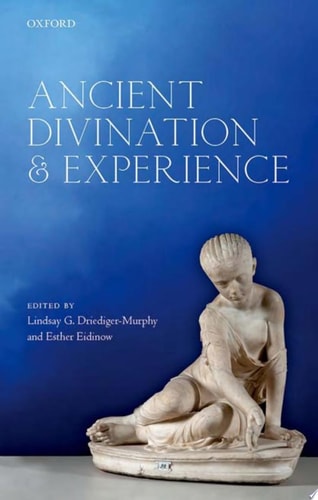
Ancient Divination and Experience
0
0
As an Amazon Associate and affiliate partner, Menrva Books earns from qualifying purchases. Learn more
Author Description
This is an open access title available under the terms of a CC BY-NC-ND 4.0 licence. It is free to read at Oxford Scholarship Online and offered as a free PDF download from OUP and selected open access locations.This volume sets out to re-examine what ancient people - primarily those in ancient Greek and Roman communities, but also Mesopotamian and Chinese cultures - thought they were doing through divination, and what this can tell us about the religions and cultures in which divination was practised. The chapters, authored by a range of established experts and upcoming early-career scholars, engage with four shared questions: What kinds of gods do ancient forms of divination presuppose? What beliefs, anxieties, and hopes did divination seek to address? What were the limits of human 'control' of divination? What kinds of human-divine relationships did divination create/sustain? The volume as a whole seeks to move beyond functionalist approaches to divination in order to identify and elucidate previously understudied aspects of ancient divinatory experience and practice. Special attention is paid to the experiences of non-elites, the perception of divine presence, the ways in which divinatory techniques could surprise their users by yielding unexpected or unwanted results, the difficulties of interpretation with which divinatory experts were thought to contend, and the possibility that divination could not just ease, but also exacerbate, anxiety in practitioners and consultants.
Menrva's Summary
THE THESIS
This volume investigates the cognitive and social functions of ancient divination by examining how practitioners across Greek, Roman, Mesopotamian, and Chinese cultures perceived their interactions with the divine. The editors, Esther Eidinow and Lindsay G. Driediger-Murphy, curate a collection of essays from established and early-career scholars to move beyond traditional functionalist interpretations. By focusing on the lived experience of divination, the authors argue that these practices were complex, often unpredictable, and deeply embedded in the anxieties and hopes of ancient populations. The work utilizes a comparative framework to analyze how divination shaped human-divine relationships and the limits of human agency.
THE SCOPE MAP
What You Will Find
- Comparative analysis of divinatory practices in Greek, Roman, Mesopotamian, and Chinese societies.
- Examination of the psychological impact of divination on both elites and non-elites.
- Scholarly exploration of the role of divine presence and the unpredictability of divinatory results.
- Methodological shift from functionalist perspectives to the study of individual experience and interpretation.
THE AUTHORITY PERSPECTIVE
Experts recognize this volume as a significant contribution to the study of ancient religious practice, particularly for its focus on the subjective experience of the practitioner. Readers frequently note the academic density of the prose, which makes it a foundational text for scholars and students interested in the intersection of ancient religion and human psychology.
Page Count:
320
Publication Date:
2019-11-26
Publisher:
Oxford University Press
ISBN-10:
0198844549
ISBN-13:
9780198844549
History
Religion
Classics
Ancient History
Greece
Divination
China religion
Rome religion
Anthropology
Iraq history
Community Tags
Similar Books