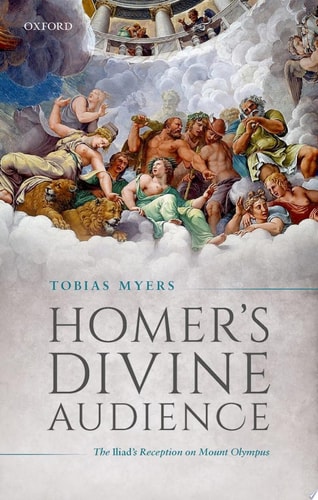
Homer's Divine Audience: The Iliad's Reception on Mount Olympus
0
0
As an Amazon Associate and affiliate partner, Menrva Books earns from qualifying purchases. Learn more
Author Description
The gods of Homer's Iliad have troubled readers for millennia, with many features of their presentation seeming to defy satisfactory explanation. Homer's Divine Audience presents and explores a new 'metaperformative' approach to scenes of divine viewing, counsel, and intervention in the Iliad, referencing the oral nature of the poem's original composition and transmission to cast the Olympian gods in part as an internal audience, who follow the action from their privileged, divine perspective much like the poet's own listeners.Although critics have already often described the gods' activities in terms of attendance at a 'show' and have suggested analogies to theatre and sports, little has yet been done to investigate the particular strategies by which the poet conveys the impression of gods attending a live, staged event. This volume's analysis of those strategies points to a 'metaperformative' significance to the motif of divine viewing: the poet is using the gods, in part, to model and thereby manipulate the ongoing dynamics of performance and live reception. The gods, like the external audience, are capable of a variety of emotional responses to events at Troy; notably pleasure and pity, but also great aloofness. By performing the speeches of the provocative, infuriating, yet ultimately obliging Zeus, the poet at key moments both challenges his listeners to take a stake in the continuation of the performance, and presents a sophisticated critique of possible responses to his poem.
Menrva's Summary
THE THESIS
This book investigates how the Olympian gods in the Iliad function as an internal audience that mirrors and shapes the experience of the poem's original listeners. Tobias Myers, a scholar of classical literature, utilizes a metaperformative framework to analyze scenes of divine intervention and observation. By examining the gods as spectators of the Trojan War, the author argues that Homer employs these figures to manipulate the reception of his oral performance and critique the emotional engagement of his audience.
THE SCOPE MAP
What You Will Find
- A metaperformative analysis of divine viewing, counsel, and intervention in the Iliad.
- An exploration of the oral tradition and the mechanics of live performance in ancient Greece.
- Examination of specific divine emotional responses, including pleasure, pity, and aloofness.
- A study of the poet's strategies for modeling audience engagement through the character of Zeus.
THE AUTHORITY PERSPECTIVE
Scholars and classicists recognize this work as a sophisticated contribution to Homeric studies that bridges the gap between textual analysis and performance theory. Readers frequently note the academic density of the prose, which is intended for those familiar with the nuances of the Iliad and classical reception theory.
Page Count:
256
Publication Date:
2019-08-27
Publisher:
Oxford University Press
ISBN-10:
019884235X
ISBN-13:
9780198842354
Philosophy
Religion
Ancient Greek
Gods Greek
Literary Criticism
Homer
Drama
Community Tags
Similar Books