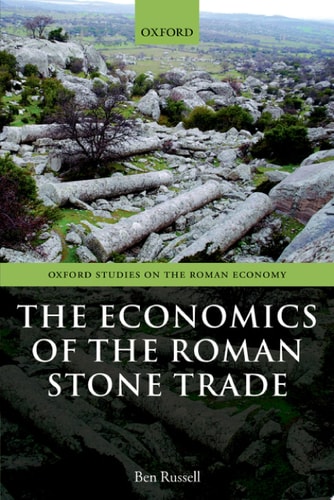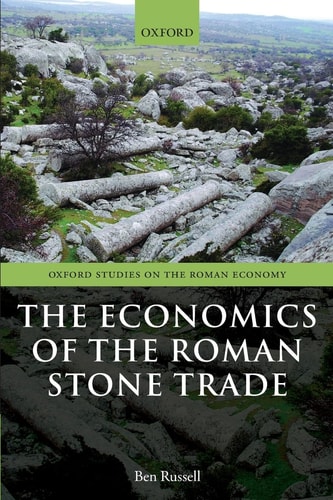
The Economics of the Roman Stone Trade
0
0
As an Amazon Associate and affiliate partner, Menrva Books earns from qualifying purchases. Learn more
Author Description
The use of stone in vast quantities is a ubiquitous and defining feature of the material culture of the Roman world. In this volume, Russell provides a new and wide-ranging examination of the production, distribution, and use of carved stone objects throughout the Roman world, including how enormous quantities of high-quality white and polychrome marbles were moved all around the Mediterranean to meet the demand for exotic material.The long-distance supply of materials for artistic and architectural production, not to mention the trade in finished objects like statues and sarcophagi, is one of the most remarkable features of the Roman world. Despite this, it has never received much attention in mainstream economic studies. Focusing on the market for stone and its supply, the administration, distribution, and chronology of quarrying, and the practicalities of stone transport, Russell offers a detailed assessment of the Roman stone trade and how the relationship between producer and customer functioned even over considerable distances.
Menrva's Summary
THE THESIS
This volume investigates the mechanisms of the Roman stone trade to determine how the production, distribution, and consumption of marble and carved stone functioned as a sophisticated economic system. Ben Russell, a specialist in Roman material culture, utilizes archaeological evidence and historical analysis to challenge the lack of attention given to the stone industry in mainstream economic studies. He examines the logistics of quarrying, the transport of heavy materials across the Mediterranean, and the complex relationship between producers and customers in the ancient world.
THE SCOPE MAP
What You Will Find
- Analysis of the production and distribution networks for white and polychrome marbles.
- Examination of the administrative and chronological aspects of Roman quarrying operations.
- Assessment of the logistical practicalities involved in the long-distance transport of stone.
- Evaluation of the market dynamics between producers and consumers of statues and sarcophagi.
THE AUTHORITY PERSPECTIVE
Scholars and historians recognize this work as a significant contribution to the study of Roman economic history and material culture. Readers frequently note the meticulous detail provided regarding the practicalities of ancient trade and the integration of archaeological data into economic theory.
Page Count:
480
Publication Date:
2019-10-15
Publisher:
Oxford University Press
ISBN-10:
0198841752
ISBN-13:
9780198841753
Economics
History
Stone carving
Archaeology