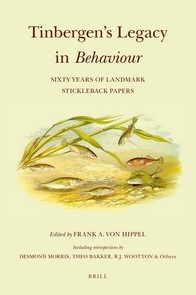
Tinbergen's Legacy in Behaviour
0
0
As an Amazon Associate and affiliate partner, Menrva Books earns from qualifying purchases. Learn more
Author Description
In a flurry of post-war productivity, Niko Tinbergen re-established his lab in Leiden, wrote landmark papers and his famous book The Study of Instinct, and founded the journal Behaviour to serve the burgeoning field of ethology. Tinbergen and his senior assistant, Jan van Iersel, published their classic paper, "Displacement reactions in the three-spined stickleback," in the first issue of the journal in 1948. Stickleback are now a powerful model in the fields of behavioral ecology, evolutionary biology, developmental genetics, and ecotoxicology - an extraordinary development for a small fish that began its modeling career among an enthusiastic core of Tinbergen students in the 1930s. From a series of clever experiments with painted model fish to the use of the sequenced genome to analyze the genetic basis of courtship, stickleback science progressed in leaps and bounds, often via seminal studies published in the pages of Behaviour. traces sixty years in the development of science using stickleback as a model, with 34 original articles covering topics ranging from homosexuality and cannibalism to genetics and speciation. Desmond Morris, Theo Bakker, Robert Wootton, Michael Bell, Tom Reimchen, Boyd Kynard, Harman Peeke, and Iain Barber provide fresh retrospectives on their republished works. Commentary by Frank von Hippel accompanies the articles.
Menrva's Summary
THE THESIS
This book traces sixty years of scientific development using the three-spined stickleback as a model organism, highlighting its foundational role in ethology and related fields. The work begins by establishing the post-war productivity of Niko Tinbergen, who re-established his lab, published key papers, and founded the journal Behaviour. It then details the progression of stickleback science, from early experiments to genomic analysis, often featuring seminal studies published in Behaviour. The book includes 34 original articles covering diverse topics and fresh retrospectives from prominent researchers.
THE SCOPE MAP
- Sixty years of scientific development using the three-spined stickleback as a model organism.
- 34 original articles covering topics from homosexuality and cannibalism to genetics and speciation.
- Retrospectives on republished works by notable scientists such as Desmond Morris and Theo Bakker.
- Commentary by Frank von Hippel accompanying the articles.
- The foundational role of Niko Tinbergen and the journal Behaviour in the field of ethology.
THE AUTHORITY PERSPECTIVE
The book is presented as a comprehensive collection celebrating the scientific legacy of Niko Tinbergen and the pivotal role of the three-spined stickleback in advancing fields like behavioral ecology and evolutionary biology. The inclusion of original articles and retrospectives from key researchers suggests a work intended for specialists and students of ethology and related disciplines. Its structure, featuring historical articles alongside contemporary commentary, points to a text that bridges the history of scientific inquiry with current research directions. The focus on a specific model organism and its sixty-year scientific trajectory indicates a detailed, scholarly examination of scientific progress.
Page Count:
539
Publication Date:
2010-01-01
ISBN-10:
9004170294
ISBN-13:
9789004170292
History
Science
Evolutionary Biology
Ethology
Genetics
Ecology
Community Tags
Similar Books