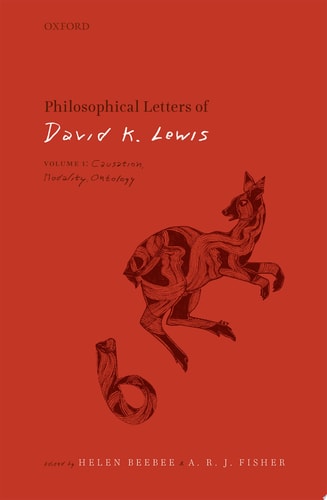
Philosophical Letters of David K. Lewis: Volume 1: Causation, Modality, Ontology
0
0
As an Amazon Associate and affiliate partner, Menrva Books earns from qualifying purchases. Learn more
Author Description
David Kellogg Lewis (1941-2001) was one of the most influential philosophers of the twentieth century. He made significant contributions to almost every area of analytic philosophy including metaphysics, philosophy of language, philosophy of mind, and philosophy of science, and set the agenda for various debates in these areas which carry on to this day. In several respects he remains a contemporary figure, yet enough time has now passed for historians of philosophy to begin to study his place in twentieth century thought. His philosophy was constructed and refined not just through his published writing, but also crucially through his life-long correspondence with fellow philosophers, including leading figures such as D.M. Armstrong, Saul Kripke, W.V. Quine, J.J.C. Smart, and Peter van Inwagen. His letters formed the undercurrent of his published work and became the medium through which he proposed many of his well-known theories and discussed a range of philosophical topics in depth.A selection of his vast correspondence over a 40-year period is presented here across two volumes. As metaphysics is arguably where Lewis made his greatest contribution, this forms the focus of Volume 1. Arranged under the broad areas of Causation, Modality, and Ontology, the letters offer an organic story of the origins, development, breadth, and depth of his metaphysics in its historical context, as well as a glimpse into the influence of his many interlocutors. This volume will be an indispensable resource for contemporary metaphysics and for those interested in the Lewisian perspective.
Menrva's Summary
THE THESIS
This volume investigates the evolution of David K. Lewis's metaphysical theories through the lens of his private correspondence with prominent twentieth-century philosophers. Editors A. R. J. Fisher and Helen Beebee curate a selection of letters spanning four decades, providing a primary source record of how Lewis refined his ideas on causation, modality, and ontology. By contextualizing these exchanges against his published works, the text illustrates the collaborative nature of analytic philosophy and the development of Lewis's intellectual framework.
THE SCOPE MAP
What You Will Find
- Detailed correspondence regarding causation, modality, and ontology.
- Insights into the collaborative development of analytic philosophy between 1960 and 2001.
- Primary source documentation of exchanges with figures such as D.M. Armstrong, Saul Kripke, and W.V. Quine.
- A chronological mapping of the refinement of Lewisian metaphysical theories.
THE AUTHORITY PERSPECTIVE
Scholars and historians of philosophy regard this collection as a foundational resource for understanding the intellectual history of analytic metaphysics. Readers frequently note the high level of technical density, making it a specialized text intended for those already familiar with Lewis's published philosophical contributions.
Page Count:
880
Publication Date:
2020-12-29
Publisher:
Oxford University Press
ISBN-10:
0198855451
ISBN-13:
9780198855453
Philosophy
Epistemology
Academic
Metaphysics
Correspondence
Community Tags
Similar Books