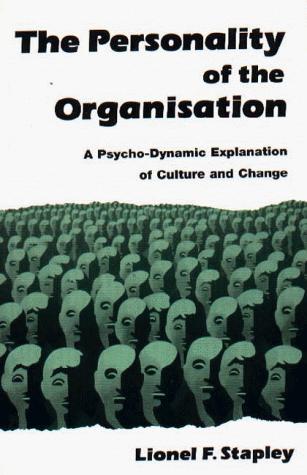
The Personality of the Organisation
0
0
As an Amazon Associate and affiliate partner, Menrva Books earns from qualifying purchases. Learn more
Author Description
Lionel Stapley believes that current theories about organisational culture fail because they concentrate on simple, surface issues. They make no attempt to deal with underlying, unconscious processes. Emotions run deep in organisations as much as they do in any other sphere of life. They run particularly deep when an organisation is going through a period of change. Taking concepts and tools from psychoanalysis, the author uses them to try to help us understand the collective feelings of members of organisations; to emphasise the role of unconscious processes in the creation of a culture and its importance to the management of change.--BOOK JACKET. Through a progressive structure, the book gives a thorough grounding in both theory and insights. Section 1 begins with a close look at the 'problem' of organisational culture pointing up the deficiencies of current theory and methodology and providing a psychodynamic way forward. Section 2 takes the reader through a number of fundamental concepts, building to a fuller psychodynamic explanation of organisational culture. Section 3 is about application and features chapters on the management of change and a case study of change in which the author was involved.--BOOK JACKET.
Menrva's Summary
THE THESIS
This book argues that current theories of organizational culture are insufficient because they overlook the profound impact of unconscious processes and deep-seated emotions. Lionel Stapley, drawing on psychoanalytic concepts, aims to illuminate the collective feelings within organizations, particularly during periods of change. The book posits that these unconscious dynamics are fundamental to the creation and management of organizational culture. It provides a psychodynamic framework to understand these underlying emotional currents and their significance for effective leadership and adaptation.
THE SCOPE MAP
- Critique of existing theories on organizational culture, highlighting their focus on surface-level issues.
- Introduction to psychodynamic concepts and tools for analyzing organizational behavior.
- Explanation of how unconscious processes contribute to the formation of organizational culture.
- Application of psychodynamic principles to the management of change within organizations.
- A detailed case study illustrating change management within an organization where the author was involved.
- Exploration of the role of emotions in organizational dynamics, especially during transitions.
- Theoretical grounding in psychoanalysis applied to the collective psyche of organizations.
THE AUTHORITY PERSPECTIVE
The book is presented as a theoretical exploration that moves beyond superficial analyses of organizational culture. It aims to provide a deeper understanding by incorporating psychodynamic principles, suggesting a more robust approach to managing change. The structure guides readers from identifying the limitations of current theories to applying psychodynamic explanations and practical case studies. The author's background in psychoanalysis informs the text's unique perspective on collective emotions and unconscious influences within corporate environments.
Page Count:
230
Publication Date:
1996-01-01
ISBN-10:
1853433411
Non-Fiction
Business
Psychology
Management
Community Tags
Similar Books