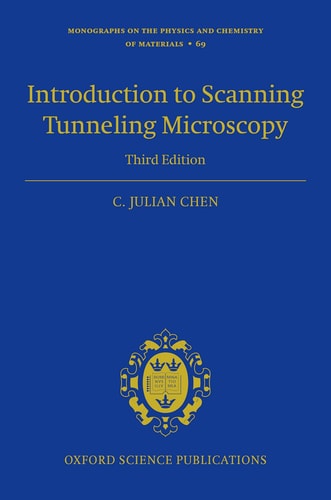
Introduction to Scanning Tunneling Microscopy: Third Edition
0
0
As an Amazon Associate and affiliate partner, Menrva Books earns from qualifying purchases. Learn more
Author Description
The scanning tunnelling microscope (STM) was invented by Binnig and Rohrer and received a Nobel Prize of Physics in 1986. Together with the atomic force microscope (AFM), it provides non-destructive atomic and subatomic resolution on surfaces. Especially, in recent years, internal details of atomic and molecular wavefunctions are observed and mapped with negligible disturbance. Since the publication of its first edition, this book has been the standard reference book and a graduate-level textbook educating several generations of nano-scientists. In Aug. 1992, the co-inventor of STM, Nobelist Heinrich Rohrer recommended: "The Introduction to Scanning tunnelling Microscopy by C.J. Chen provides a good introduction to the field for newcomers and it also contains valuable material and hints for the experts". For the second edition, a 2017 book review published in the Journal of Applied Crystallography said "Introduction to Scanning tunnelling Microscopy is an excellent book that can serve as a standard introduction for everyone that starts working with scanning probe microscopes, and a useful reference book for those more advanced in the field". The third edition is a thoroughly updated and improved version of the recognized "Bible" of the field.Additions to the third edition include: theory, method, results, and interpretations of the non-destructive observation and mapping of atomic and molecular wavefunctions; elementary theory and new verifications of equivalence of chemical bond interaction and tunnelling; scanning tunnelling spectroscopy of high Tc superconductors; imaging of self-assembled organic molecules on the solid-liquid interfaces. Some key derivations are rewritten using mathematics at an undergraduate level to make it pedagogically sound.
Menrva's Summary
THE THESIS
This text investigates the theoretical foundations, practical methodologies, and advanced applications of scanning tunneling microscopy (STM) within the field of surface science. Author C. Julian Chen, a recognized expert in the field, provides a comprehensive framework that bridges the gap between fundamental quantum mechanics and the experimental observation of atomic and molecular structures. The book serves as both an instructional guide for students and a technical reference for researchers, utilizing updated mathematical derivations to explain complex phenomena such as wavefunctions and chemical bond interactions.
THE SCOPE MAP
What You Will Find
- Theoretical principles of quantum tunneling and its equivalence to chemical bond interaction.
- Methodologies for non-destructive imaging and mapping of atomic and molecular wavefunctions.
- Technical analysis of scanning tunneling spectroscopy, specifically regarding high Tc superconductors.
- Practical applications for imaging self-assembled organic molecules at solid-liquid interfaces.
THE AUTHORITY PERSPECTIVE
Experts and academic reviewers consistently identify this work as the foundational reference for the field of scanning probe microscopy. Readers frequently note the balance between pedagogical clarity for newcomers and the technical depth required by established researchers in the physical sciences.
Page Count:
496
Publication Date:
2021-05-30
Publisher:
Oxford University Press
ISBN-10:
0198856555
ISBN-13:
9780198856559
Science
textbook
Chemistry
Microscopy
Nanotechnology
Physics
Community Tags
Similar Books