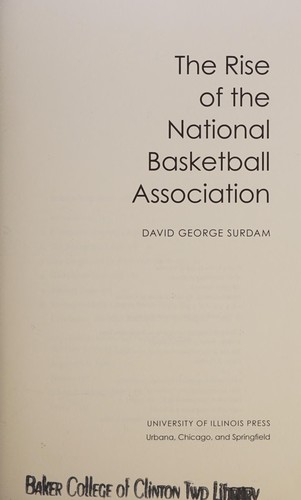
The Rise of the National Basketball Association
0
0
As an Amazon Associate and affiliate partner, Menrva Books earns from qualifying purchases. Learn more
Author Description
Today's National Basketball Association commands millions of spectators worldwide, and its many franchises are worth hundreds of millions of dollars. But the league wasn't always so successful or glamorous: in the 1940s and 1950s, the NBA and its predecessor, the Basketball Association of America, were scrambling to attract fans. Teams frequently played in dingy gymnasiums, players traveled as best they could, and their paychecks could bounce higher than a basketball. How did the NBA evolve from an obscure organization facing financial losses to a successful fledgling sports enterprise by 1960? Drawing on information from numerous archives, newspaper and periodical articles, and Congressional hearings, The Rise of the National Basketball Association chronicles the league's growing pains from 1946 to 1961. David George Surdam describes how a handful of ambitious ice hockey arena owners created the league as a way to increase the use of their facilities, growing the organization by fits and starts. Rigorously analyzing financial data and league records, Surdam points to the innovations that helped the NBA thrive: regular experiments with rules changes to make the game more attractive to fans, and the emergence of televised sports coverage as a way of capturing a larger audience. Notably, the NBA integrated in 1950, opening the game to players who would dominate the game by the end of the 1950s decade: Bill Russell, Elgin Baylor, Wilt Chamberlain, and Oscar Robertson. Long a game that players loved to play, basketball became a professional sport well supported by community leaders, business vendors, and an ever-growing number of fans.
Menrva's Summary
THE THESIS
The National Basketball Association evolved from an obscure, financially unstable league in the 1940s and 1950s into a globally recognized sports enterprise by 1960. David George Surdam's work details the league's formative years, tracing its origins to ice hockey arena owners seeking to maximize facility usage. The book examines the challenges of attracting fans, the financial precariousness of early franchises, and the strategic innovations that propelled the NBA's growth. These innovations included rule changes to enhance game appeal and the crucial adoption of televised sports coverage.
THE SCOPE MAP
- The creation of the Basketball Association of America (BAA) and its merger with the National Basketball League (NBL) to form the NBA.
- Analysis of the financial struggles and business models of early NBA franchises.
- The role of ice hockey arena owners in establishing and supporting the league.
- Examination of rule changes implemented to improve the game's entertainment value.
- The impact of televised sports on the NBA's audience growth and popularity.
- The integration of the NBA in 1950 and its effect on player talent.
- The emergence of iconic players who defined the league by the late 1950s.
THE AUTHORITY PERSPECTIVE
The book meticulously chronicles the NBA's challenging ascent from its inception through the 1950s, highlighting the strategic business decisions and on-court developments that shaped its future success. Surdam's analysis, grounded in extensive archival research, details how rule innovations and the advent of television transformed the league. The integration of players in 1950 is presented as a pivotal moment, paving the way for the dominance of future stars and the sport's broader appeal. This comprehensive account positions the NBA's rise as a significant narrative in the history of professional sports and American business.
Page Count:
247
Publication Date:
2012-01-01
ISBN-10:
0252037138
ISBN-13:
9780252037139
History
Non-Fiction
Business History
Basketball
Sports History
Community Tags
Similar Books