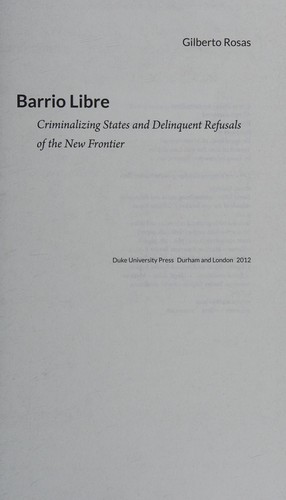
Barrio Libre
0
0
As an Amazon Associate and affiliate partner, Menrva Books earns from qualifying purchases. Learn more
Author Description
The city of Nogales straddles the border running between Arizona and Sonora, Mexico. On the Mexican side, marginalized youths calling themselves Barrio Libre (Free 'Hood) employ violence, theft, and bribery to survive, often preying on undocumented migrants who navigate the city's sewer system to cross the US-Mexico border. In this book, Gilberto Rosas draws on his in-depth ethnographic research among the members of Barrio Libre to understand why they have embraced criminality and how neoliberalism and security policies on both sides of the border have affected the youths' descent into Barrio Libre. Rosas argues that although these youths participate in the victimization of others, they should not be demonized. They are complexly and adversely situated. The effects of NAFTA have forced many of them, as well as other Mexicans, to migrate to Nogales. Moving fluidly with the youths through the spaces that they inhabit and control, he shows how the militarization of the border actually destabilized the region and led Barrio Libre to turn to increasingly violent activities, including drug trafficking. By focusing on these youths and their delinquency, Rosas demonstrates how capitalism and criminality shape perceptions and experiences of race, sovereignty, and resistance along the US-Mexico border. Gilberto Rosas is Assistant Professor in the Departments of Anthropology and Latina/Latino Studies at the University of Illinois, Urbana-Champaign. Publisher's note.
Menrva's Summary
THE THESIS
This book investigates the complex socio-economic factors driving marginalized youth in Nogales, Mexico, to embrace criminality and victimize undocumented migrants. Gilberto Rosas, an Assistant Professor of Anthropology and Latina/Latino Studies, draws on extensive ethnographic research among the members of Barrio Libre to explore their motivations and the systemic forces that shape their lives. The book examines how neoliberal policies, particularly the effects of NAFTA, and increased border security have destabilized the region, pushing these youths into increasingly violent activities like drug trafficking. Rosas argues against demonizing these youths, presenting them as adversely situated individuals whose experiences of race, sovereignty, and resistance are intricately shaped by capitalism and criminality along the US-Mexico border.
THE SCOPE MAP
- In-depth ethnographic research among marginalized youths in Nogales, Mexico, known as Barrio Libre.
- Analysis of the impact of neoliberalism and security policies on youth criminality.
- Exploration of how NAFTA and border militarization have destabilized the region.
- Examination of the youths' involvement in violence, theft, bribery, and preying on undocumented migrants.
- Discussion of how capitalism and criminality shape perceptions of race, sovereignty, and resistance.
- Case studies and ethnographic accounts of individual members of Barrio Libre.
- The role of the sewer system as a crossing point for undocumented migrants.
THE AUTHORITY PERSPECTIVE
This book offers a critical examination of the social and economic conditions that foster criminality among marginalized youth on the US-Mexico border. It challenges simplistic views of delinquency by situating the actions of Barrio Libre members within broader political and economic contexts, such as the effects of NAFTA and border militarization. The work is likely to appeal to scholars and students of anthropology, sociology, criminology, and Latin American studies interested in border dynamics and the human consequences of global economic policies.
Page Count:
188
Publication Date:
2012-01-01
ISBN-10:
0822352257
ISBN-13:
9780822352259
History
Politics
Crime
Non-Fiction
Sociology
Border Studies
Anthropology
Criminology
Community Tags
Similar Books