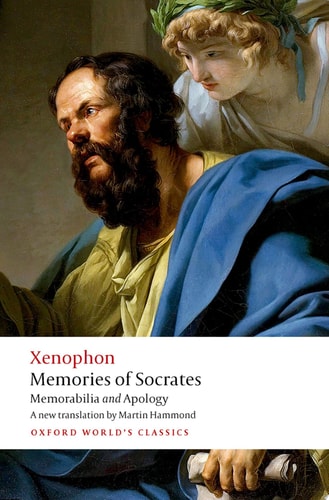
Memories of Socrates: Memorabilia and Apology
0
0
As an Amazon Associate and affiliate partner, Menrva Books earns from qualifying purchases. Learn more
Author Description
'Who would you say knows himself?'In 399 BCE Socrates was tried in Athens on charges of irreligion and corruption of the young, convicted, and sentenced to death. Like Plato, an almost exact contemporary, in his youth Xenophon (c. 430-c. 354 BCE) was one of the circle of mainly upper-class young Athenians attracted to Socrates' teaching. His Memorabilia is both a passionate defence of Socrates against those charges, and a kaleidoscopic picture of the man he knew, painted in a series of mini-dialogues and shorter vignettes, with a varied and deftly characterized cast--entitled and ambitious young men, atheists and hedonists, artists and artisans, Socrates' own stroppy teenage son Lamprocles, the glamorous courtesan Theodote. Topics given Socrates' characteristic questioning treatment include education, law, justice, government, political and military leadership, democracy and tyranny, friendship, care of the body and the soul, and concepts of the divine. Xenophon sees Socrates as above all a supreme moral educator, coaxing and challenging his associates to make themselves better people, not least by the example of how he lived his own life. Self-knowledge, leading to a reasoned self-control, was for Socrates the essential first step on the path to virtue, and some found it uncomfortable. The Apology is a moving account of Socrates' behaviour and bearing in his last days, immediately before, during, and after his trial.
Menrva's Summary
THE THESIS
This work investigates the character, moral teachings, and final days of Socrates through the firsthand observations of his student, Xenophon. The text presents a defense against the historical charges of irreligion and corruption of the youth brought against the philosopher in 399 BCE. By compiling the Memorabilia and the Apology, the authors provide a structured argument that Socrates functioned primarily as a moral educator who prioritized self-knowledge and self-control as the foundations of virtue.
THE SCOPE MAP
What You Will Find
- A detailed account of the trial and final days of Socrates in Athens.
- A series of vignettes and dialogues covering topics such as justice, leadership, and the divine.
- Primary source perspectives on the social and political climate of 4th-century BCE Athens.
- An analysis of Socratic methodology regarding education and the care of the soul.
THE AUTHORITY PERSPECTIVE
Scholars and classicists frequently cite this edition as a foundational text for understanding the Socratic tradition outside of the Platonic dialogues. Readers often note the accessibility of the prose, which makes these ancient philosophical arguments clear for both students and general audiences.
Page Count:
304
Publication Date:
2023-06-23
Publisher:
Oxford University Press
ISBN-10:
0198856091
ISBN-13:
9780198856092
Biography
Philosophy
Classics
Ethics
Ancient History
Community Tags
Similar Books