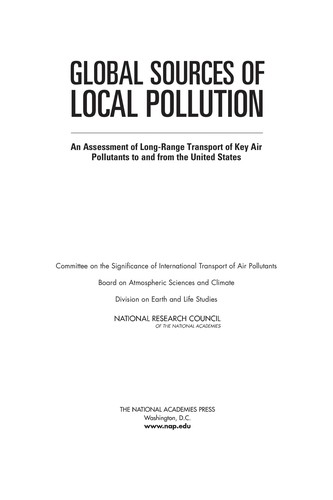
Global Sources of Local Pollution
0
0
As an Amazon Associate and affiliate partner, Menrva Books earns from qualifying purchases. Learn more
Author Description
Recent advances in air pollution monitoring and modeling capabilities have made it possible to show that air pollution can be transported long distances and that adverse impacts of emitted pollutants cannot be confined to one country or even one continent. Pollutants from traffic, cooking stoves, and factories emitted half a world away can make the air we inhale today more hazardous for our health. The relative importance of this 'imported' pollution is likely to increase, as emissions in developing countries grow, and air quality standards in industrial countries are tightened. Global Sources of Local Pollution examines the impact of the long-range transport of four key air pollutants (ozone, particulate matter, mercury, and persistent organic pollutants) on air quality and pollutant deposition in the United States. It also explores the environmental impacts of U.S. emissions on other parts of the world. The book recommends that the United States work with the international community to develop an integrated system for determining pollution sources and impacts and to design effective response strategies
Menrva's Summary
THE THESIS
The book investigates the significant impact of transboundary air pollution on local air quality and health. The National Research Council's Committee on the Significance of International Transport of Air Pollutants examines how pollutants originating from distant sources, such as traffic, cooking stoves, and factories, can degrade air quality even in regions with stringent environmental standards. The report focuses on the long-range transport of ozone, particulate matter, mercury, and persistent organic pollutants, assessing their effects on the United States and the environmental consequences of U.S. emissions abroad. It argues for a coordinated international approach to source identification, impact assessment, and the development of effective pollution control strategies.
THE SCOPE MAP
- Analysis of the long-range transport of ozone and its impact on U.S. air quality.
- Examination of particulate matter transport and its deposition within the United States.
- Assessment of mercury transport and its environmental consequences.
- Investigation into the impact of persistent organic pollutants (POPs) on U.S. air quality and deposition.
- Evaluation of the environmental impacts of U.S. emissions on other countries.
- Recommendations for an integrated international system for pollution source determination and impact assessment.
- Proposals for designing effective global response strategies to air pollution.
THE AUTHORITY PERSPECTIVE
The book is regarded as a comprehensive assessment of the growing challenge posed by transboundary air pollution. It highlights the increasing importance of 'imported' pollution as emissions shift globally and domestic standards tighten. The report's findings underscore the necessity of international cooperation for effective air quality management. The recommendations advocate for a unified global framework to address the complex sources and impacts of air pollution.
Page Count:
234
Publication Date:
2010-01-01
ISBN-10:
0309144019
ISBN-13:
9780309144018
Non-Fiction
Science
Pollution
International relations
Public Health
Air Quality
Community Tags
Similar Books