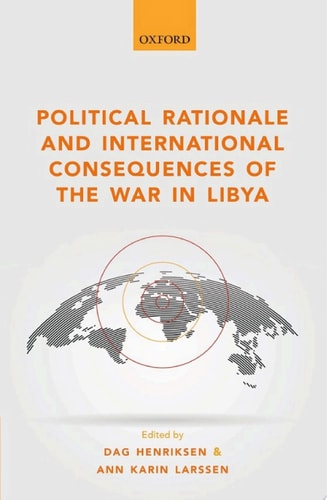
Political Rationale and International Consequences of the War in Libya
0
0
As an Amazon Associate and affiliate partner, Menrva Books earns from qualifying purchases. Learn more
Author Description
Political Rationale and International Consequences of the War in Libya focuses on the international intervention in Libya in 2011, and tries to answer two broad questions; (1) What was the political rationale for the various actors to proceed as they did in the lead-up and conduct of the military intervention in Libya?, (2) What are the consequences of the UN-authorized military intervention in Libya? R2P was the public raison d'être of the war, and an important legitimizing factor of the intervention. Still, the humanitarian situation was a necessary, but not in and by itself an adequate precondition for intervention. A number of factors coalesced to enable the intervention. While the humanitarian situation triggered the intervention, in reality a variety of national interests governed the approach by the various international actors, and more often than not, these motives were not rooted in the particular circumstances in Libya. The book offers a combination of unique perspectives. While the perspectives of the US, France, and the UK on the Libyan Crisis/War have been well documented, the Arabic and Scandinavian political and military dynamics have been much less so. While the perspectives of NATO, the UN, and R2P have been debated, the view from the Arab League and African Union (AU) have been less in focus. The volume redresses that imbalance and offers the most broad-ranging analysis yet of a key moment in recent international relations.
Menrva's Summary
THE THESIS
This volume investigates the underlying political motivations and the subsequent international consequences of the 2011 military intervention in Libya. Editors Ann Karin Larssen and Dag Henriksen compile a series of expert analyses to determine whether the Responsibility to Protect (R2P) doctrine served as a genuine humanitarian catalyst or as a legitimizing facade for broader national interests. The text evaluates how diverse actors, ranging from Western powers to regional organizations, navigated the complex geopolitical landscape of the Libyan crisis.
THE SCOPE MAP
What You Will Find
- Comparative analysis of national interests versus humanitarian rhetoric in military interventions.
- Examination of the decision-making processes within the UN, NATO, the Arab League, and the African Union.
- Case studies focusing on Scandinavian and Arab political and military dynamics.
- Evaluation of the long-term geopolitical impact of the 2011 intervention.
Scope Limits
- The book does not provide a comprehensive tactical history of the ground combat operations.
- It does not offer a detailed biography of the individual political leaders involved in the conflict.
THE AUTHORITY PERSPECTIVE
Experts highlight this work as a significant contribution to international relations literature for its inclusion of under-represented perspectives from the Arab League and the African Union. Readers frequently note the academic density of the prose, which makes it a valuable resource for scholars and policy analysts studying the complexities of modern interventionism.
Page Count:
354
Publication Date:
2016-01-01
Publisher:
OUP Oxford
ISBN-10:
0191080160
ISBN-13:
9780191080166
Politics & Government
Foreign Policy
Military History
Middle Eastern
International relations
Professional Career & Trade
Humanitarian intervention
Community Tags
Similar Books