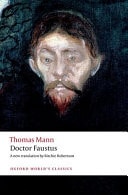
Doctor Faustus
0
0
As an Amazon Associate and affiliate partner, Menrva Books earns from qualifying purchases. Learn more
Author Description
Adrian Leverkühn Is A Composer Who, At Terrible Personal Cost, Makes The Breakthrough From Traditional Art To Extreme Modernism And Success. Creative And Brilliant, He Will Stop At Nothing To Achieve Greatness. Thomas Mann Wrote Doctor Faustus (1947) In American Exile During And Just After The Second World War. A Prominent And Long-standing Defender Of Democracy, He Sought To Understand, In Cultural And Intellectual Terms, How Germany Had Succumbed To Nazism. Mann Structures His Story Through References To The German Legend Of Faust And His Pact With The Devil. The Life Of The Solitary Composer, An Ultimately Tragic Figure, Is Recounted By His Friend And Biographer, Who Represents A Sadly Ineffectual Humanism, And Whose Social Activities Provide A Panorama Of Middle-class German Society In The Early Twentieth Century. Ritchie Robertson's New English Translation Is Accompanied By Detailed Annotations And An Introduction Illuminating The Themes Of The Novel-- Provided By Publisher.
Menrva's Summary
THE PULSE
A brilliant composer enters into a pact with the devil to achieve artistic transcendence, only to face the devastating consequences of his ambition. Adrian Leverkühn seeks to revolutionize music, pushing past the boundaries of traditional composition into a realm of extreme modernism. His pursuit of greatness is documented by his lifelong friend, Serenus Zeitblom, whose narration provides a humanistic lens through which to view Leverkühn's descent. The narrative operates as a complex intellectual biography, mirroring the moral and cultural collapse of Germany during the early twentieth century.
INSIDE THE PAGES
- Use of the Faustian legend as a structural allegory for artistic and national corruption
- First-person narrative framework provided by a sympathetic but detached biographer
- Integration of music theory and aesthetic philosophy into the character's development
- Detailed depiction of early twentieth-century German intellectual and middle-class society
- Non-linear reflections on the political climate of the era
- Exploration of the relationship between genius and mental instability
- Symbolic representation of the pact as a metaphor for the rise of totalitarianism
- Dense, erudite prose style characteristic of the author's later period
THE COLLECTIVE ECHO
Readers frequently highlight the intellectual density of the prose, noting that the novel requires significant patience to navigate its philosophical inquiries. Discussion often centers on the parallel between the protagonist's personal decline and the broader historical trajectory of Germany toward Nazism. Critics emphasize the effectiveness of the biographer's voice in grounding the more abstract, esoteric discussions of music and theology. The atmosphere is consistently described as somber and reflective, focusing heavily on the moral cost of artistic innovation. Many readers find the interplay between the mythic Faustian elements and the realistic historical setting to be the most compelling aspect of the work.
Page Count:
0
Publication Date:
2026-01-01
Publisher:
New York : Oxford University Press,
ISBN-10:
0198867727
ISBN-13:
9780198867722
Tragedy
classic
Modernism
Philosophical
Historical
Community Tags
Similar Books