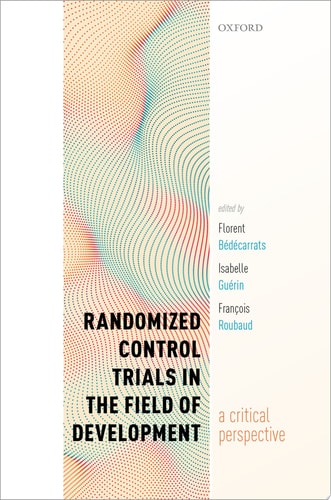
Randomized Control Trials in the Field of Development: A Critical Perspective
0
0
As an Amazon Associate and affiliate partner, Menrva Books earns from qualifying purchases. Learn more
Author Description
This is an open access title available under the terms of a CC BY-NC-ND 4.0 International licence. It is free to read at Oxford Academic and offered as a free PDF download from OUP and selected open access locations.In October 2019, Abhijit Banerjee, Esther Duflo, and Michael Kremer jointly won the 51st Sveriges Riksbank Prize in Economic Sciences in Memory of Alfred Nobel "for their experimental approach to alleviating global poverty." But what is the exact scope of their experimental method, known as randomized control trials (RCTs)? Which sorts of questions are RCTs able to address and which do they fail to answer? The first of its kind, Randomized Control Trials in the Field of Development: A Critical Perspective provides answers to these questions, explaining how RCTs work, what they can achieve, why they sometimes fail, how they can be improved and why other methods are both useful and necessary. Bringing together leading specialists in the field from a range of backgrounds and disciplines (economics, econometrics, mathematics, statistics, political economy, socioeconomics, anthropology, philosophy, global health, epidemiology, and medicine), it presents a full and coherent picture of the main strengths and weaknesses of RCTs in the field of development. Looking beyond the epistemological, political, and ethical differences underlying many of the disagreements surrounding RCTs, it explores the implementation of RCTs on the ground, outside of their ideal theoretical conditions and reveals some unsuspected uses and effects, their disruptive potential, but also their political uses. The contributions uncover the implicit worldview that many RCTs draw on and disseminate, and probe the gap between the method's narrow scope and its success, while also proposing improvements and alternatives.Without disputing the contribution of RCTs to scientific knowledge, Randomized Control Trials in the Field of Development warns against the potential dangers of their excessive use.
Menrva's Summary
THE THESIS
This work investigates the methodological scope, practical limitations, and epistemological implications of randomized control trials (RCTs) within the context of global development economics. The authors, Florent Bédécarrats, François Roubaud, and Isabelle Guérin, curate a multidisciplinary collection of essays from experts in fields ranging from econometrics to anthropology. By examining the gap between theoretical experimental design and real-world implementation, the text argues for a more nuanced application of RCTs and advocates for the integration of complementary research methodologies to address complex poverty alleviation challenges.
THE SCOPE MAP
What You Will Find
- A comprehensive analysis of the experimental methods used by Nobel laureates in development economics.
- A multidisciplinary critique involving perspectives from political economy, statistics, and philosophy.
- Case studies illustrating the practical challenges of implementing RCTs outside of controlled laboratory environments.
- An evaluation of the ethical, political, and epistemological consequences of relying exclusively on experimental data.
THE AUTHORITY PERSPECTIVE
Experts recognize this volume as a significant contribution to the ongoing debate regarding the dominance of experimental methods in development policy. Readers frequently note the academic density of the prose, which serves as a foundational resource for scholars and practitioners seeking to understand the limitations of current poverty alleviation research.
Page Count:
448
Publication Date:
2020-11-07
Publisher:
Oxford University Press
ISBN-10:
0198865368
ISBN-13:
9780198865360
Economics
Public Policy
Statistics
Social Science
Methodology
Community Tags
Similar Books










Reader Comments
Share Your Thoughts
No comments yet. Be the first to share your thoughts!