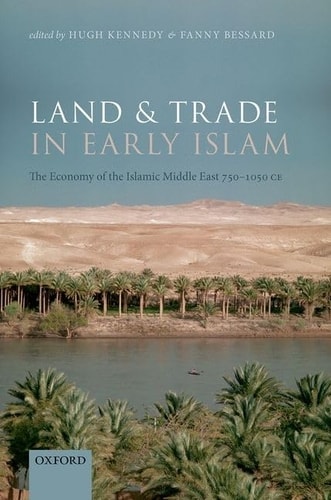
Land and Trade in Early Islam: The Economy of the Islamic Middle East 750-1050 CE
0
0
As an Amazon Associate and affiliate partner, Menrva Books earns from qualifying purchases. Learn more
Author Description
Land and Trade in Early Islam discusses the latest developments in the field of early Islamic economic and social history, and explores the notion of polycentrism and the dialectic between global and local between 700 and 1050 CE. The volume explores the political mechanisms and the role of Islamic states in regulating and developing demand in the economy. The chapters question the binary of core/periphery, and demonstrate how the growing scholarship on the liminal regions of the Caliphate has transformed our understanding of the early Islamic world by offering a more nuanced picture of its regional urban and socio-economic dynamics. Changes in the peripheries of the early medieval Caliphate have traditionally been conceived as resulting from initiatives by the core. An increased focus on the comparatively under-explored regions in central Asia, north Africa, south-east Asia and the Caucasus has thrown this into question. Land and Trade in Early Islam draws on this growing body of scholarship to question the notion of peripherality, explore lines of economic influence and interdependence, and to better understand the regional economic, social and political dynamics of this period.
Menrva's Summary
THE THESIS
This volume investigates the economic and social structures of the early Islamic world between 750 and 1050 CE to determine how regional dynamics challenged the traditional core-periphery model of the Caliphate. Fanny Bessard and Hugh Kennedy synthesize recent archaeological and historical scholarship to argue that the economic development of the Islamic Middle East was characterized by polycentrism rather than centralized control. By examining the interplay between state regulation and local demand, the authors provide a framework for understanding how liminal regions influenced the broader economic landscape of the medieval period.
THE SCOPE MAP
What You Will Find
- Analysis of economic and social history across the Caliphate from 750 to 1050 CE.
- Examination of regional urban dynamics in Central Asia, North Africa, and the Caucasus.
- Critical evaluation of the core-periphery binary in early Islamic political history.
- Discussion of state-led mechanisms for regulating and stimulating economic demand.
THE AUTHORITY PERSPECTIVE
Scholars and historians identify this work as a significant contribution to the study of medieval Islamic economic systems, particularly for its focus on under-explored peripheral regions. Readers frequently note the academic density of the prose and the rigorous synthesis of recent archaeological findings, making it a valuable resource for specialists in the field.
Page Count:
576
Publication Date:
2023-08-25
Publisher:
Oxford University Press
ISBN-10:
019886308X
ISBN-13:
9780198863083
History
Economics
Asia history
Islamic Studies
Community Tags
Similar Books