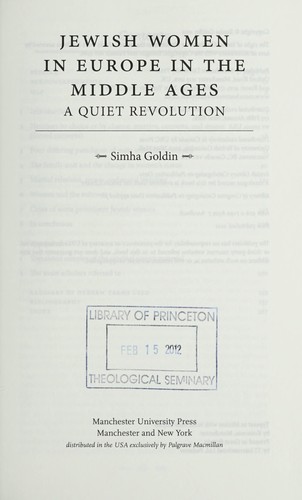
Jewish Women in Europe in the Middle Ages
0
0
As an Amazon Associate and affiliate partner, Menrva Books earns from qualifying purchases. Learn more
Author Description
The social structure of medieval Jewry was dominated by men who did not regard women as sharing equal status, and who took responsibility for the entire community, women included. This leadership sought to strengthen the family, the backbone of Jewish society, while attempting to improve their security within the Christian society which was seeking to displace them. However, this wider aim required improvement in status for women, which would provoke internal opposition within the Jewish community. Goldin's study depicts a social conflict within a community, a conflict that was gender oriented, but primarily social in nature. The twelfth century witnessed fundamental changes in the status of Jewish women in terms of their relationships with their husbands and within the family. The prohibiting of polygamy and divorce without the woman's consent gave rise to a quiet revolution. This engaging study looks closely at the changing attitudes towards women and the changes in her social status. Goldin highlights the case of Licoricia of Winchester, who in 1240 married David of Oxford, one of the wealthiest Jews in England - a moneylender whose clients included the King himself. Licoricia was very active with her husband in their joint enterprises. Four years after their marriage, David died leaving her with so vast a fortune that a royal decree was issued for her arrest and she was placed in the Tower of London. Using original Hebrew sources, this engaging study explores the relationships between men and women within Jewish society and the examinable factors in the functioning of community.--Publisher's website.
Menrva's Summary
THE THESIS
This study investigates the evolving social status and agency of Jewish women in medieval Europe, particularly focusing on the internal community dynamics and external pressures that shaped their lives. The author examines how patriarchal structures within medieval Jewry, while aiming to strengthen the family and community, paradoxically necessitated an improvement in women's status, leading to internal conflict. The text highlights significant shifts in the 12th century, including the prohibition of polygamy and the requirement of a woman's consent for divorce, which initiated a quiet revolution in marital and familial relationships. Through original Hebrew sources, the book analyzes these changing attitudes and their impact on women's social standing, using the notable case of Licoricia of Winchester as a detailed example of a woman actively involved in significant financial enterprises.
THE SCOPE MAP
- Analysis of the patriarchal social structure of medieval Jewry and its impact on women's status.
- Exploration of the internal community conflicts arising from attempts to improve women's social standing.
- Examination of the fundamental changes in the status of Jewish women during the 12th century.
- Discussion on the prohibition of polygamy and the requirement of women's consent in divorce proceedings.
- Detailed case study of Licoricia of Winchester, a prominent Jewish woman involved in significant financial enterprises.
- Utilizes original Hebrew sources to reconstruct the lives and roles of Jewish women.
- Investigates the relationships between men and women within medieval Jewish society.
- Analyzes the factors influencing the functioning and social dynamics of the Jewish community.
THE AUTHORITY PERSPECTIVE
This scholarly work is recognized for its in-depth exploration of a specific demographic often overlooked in broader historical narratives. The use of original Hebrew sources lends significant authority to its findings, providing a nuanced perspective on the social and gender dynamics within medieval Jewish communities. The detailed case study of Licoricia of Winchester serves as a compelling focal point, illustrating the complex interplay of personal agency, economic activity, and societal constraints faced by Jewish women. The book is noted for its analytical approach to social conflict, framing it as primarily social in nature with gender as a key, but not sole, determinant.
Page Count:
271
Publication Date:
2011-01-01
ISBN-10:
071908329X
ISBN-13:
9780719083297
Non-Fiction
History
Jewish Studies
Social History
Community Tags
Similar Books