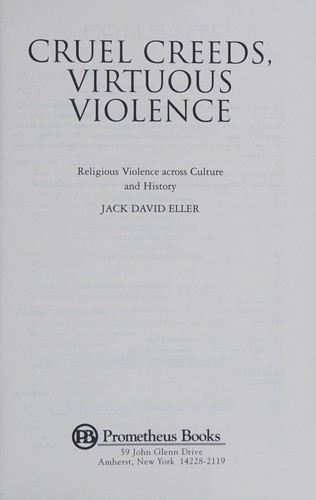
Cruel Creeds, Virtuous Violence
0
0
As an Amazon Associate and affiliate partner, Menrva Books earns from qualifying purchases. Learn more
Author Description
Throughout this compelling investigation, the author locates himself and remains firmly planted on that narrow patch of middle ground between blaming all violence on religion and claiming that religion is purely nonviolent and peaceful. Before his analysis begins in earnest, he first fleshes out the meanings of religion and violence, a step that is often skipped and yet is absolutely critical if we are ever to fully understand and resolve the phenomenon of religious violence. Without a doubt, religion, violence, and nonviolence are complicated concepts, but the road to ending or reducing religious violence does not necessarily have to be so fraught with accusations, conflicting views, and dismissive attitudes. After clearing away many misconceptions about religious violence as well as numerous easy and all-to-improbable solutions, he details a realistic approach to creating a more peaceful future. -- From book Jacket. The phrase "religious violence" often brings to mind dramatic events: the September 11 attack on the World Trade Center, riots in India between Muslims and Hindus, or, farther back in history, the Crusades and the Thirty Years War. But as the author, an anthropologist shows in this study, violence in connection with religion is a very broad based phenomenon encompassing all cultures and including a wide variety of activities and complex motives. He presents a wealth of case material, demonstrating the many manifestations of religious violence, not just war and terrorism, which are the focus of so many discussions of religiously motivated violence, but also more prevalent forms. He devotes separate chapters to: sacrifice (both animal and human); self-mortification (including self-injury, asceticism, and martyrdom); religious persecution (from anti-Semitic pogroms to witchhunts); ethno-religious conflict (including such hotspots as Sri Lanka, Northern Ireland, and the former Yugoslavia); religious wars (from the ancient Hebrews' wars and the Christian C
Menrva's Summary
THE THESIS
This book investigates the complex and often misunderstood relationship between religion and violence, seeking to move beyond simplistic explanations. The author, an anthropologist, argues that religious violence is a broad phenomenon encompassing diverse activities and motives across cultures, not limited to dramatic events like terrorism or historical wars. He critically examines definitions of religion and violence, essential steps often overlooked in understanding this issue. The work proposes a realistic approach to reducing religious violence by clearing away misconceptions and improbable solutions, aiming for a more peaceful future.
THE SCOPE MAP
- Definitions of religion and violence
- Analysis of sacrifice (animal and human)
- Examination of self-mortification (asceticism, martyrdom)
- Exploration of religious persecution (e.g., pogroms, witchhunts)
- Case studies of ethno-religious conflict (e.g., Sri Lanka, Northern Ireland, former Yugoslavia)
- Discussion of religious wars throughout history (e.g., ancient Hebrews, Christian Crusades)
- Exploration of prevalent, less-discussed forms of religious violence beyond war and terrorism
THE AUTHORITY PERSPECTIVE
The book is characterized as a compelling investigation that firmly plants itself in a middle ground, avoiding extreme views on religion's role in violence. It is noted for its critical examination of the definitions of religion and violence, which are deemed essential for understanding the phenomenon. The author's approach is described as realistic, aiming to clear misconceptions and offer practical steps toward a more peaceful future. The work is praised for presenting a wealth of case material that demonstrates the broad scope of religious violence across cultures.
Page Count:
451
Publication Date:
2010-01-01
ISBN-10:
1616142189
ISBN-13:
9781616142186
Non-Fiction
History
Religion
Anthropology
Sociology
Community Tags
Similar Books














