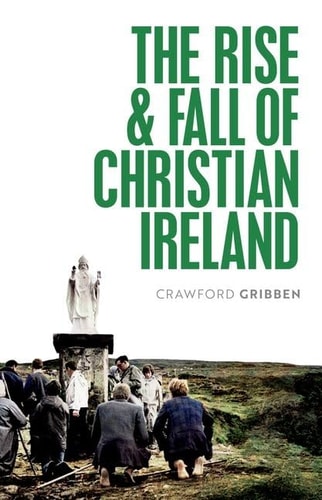
The Rise and Fall of Christian Ireland
0
0
As an Amazon Associate and affiliate partner, Menrva Books earns from qualifying purchases. Learn more
Author Description
Ireland has long been regarded as a 'land of saints and scholars'. Yet the Irish experience of Christianity has never been simple or uncomplicated. The Rise and Fall of Christian Ireland describes the emergence, long dominance, sudden division, and recent decline of Ireland's most important religion, as a way of telling the history of the island and its peoples.Throughout its long history, Christianity in Ireland has lurched from crisis to crisis. Surviving the hostility of earlier religious cultures and the depredations of Vikings, evolving in the face of Gregorian reformation in the 11th and 12th centuries and more radical protestant renewal from the 16th century, Christianity has shaped in foundational ways how the Irish have understood themselves and their place in the world. And the Irish have shaped Christianity, too. Their churches have staffed some of the religion's most important institutions and developed some of its some of its most popular ideas.But the Irish church, like the island, is divided. After 1922, a border marked out two jurisdictions with competing religious politics. The southern state turned to the Catholic church to shape its social mores, until it emerged from an experience of sudden-onset secularization to become one of the most progressive nations in Europe. The northern state moved more slowly beyond the protestant culture of its principal institutions, but in a similar direction of travel.In 2021, fifteen hundred years on from the birth of Saint Columba, Christian Ireland appears to be vanishing. But its critics need not relax any more than believers ought to despair. After the failure of several varieties of religious nationalism, what looks like irredeemable failure might actually be a second chance. In the ruins of the church, new Columbas and Patricks shape the rise of another Christian Ireland.
Menrva's Summary
THE THESIS
This book investigates the historical trajectory of Christianity in Ireland, questioning how a nation once defined as a 'land of saints and scholars' transitioned into a state of rapid secularization. Crawford Gribben, a professor of history, utilizes a broad chronological framework to examine the interplay between Irish identity and religious institutional power. He argues that the evolution of the Irish church is inseparable from the island's political divisions and that the current decline of traditional religious influence may signal a transformative period rather than a permanent end.
THE SCOPE MAP
What You Will Find
- A comprehensive historical survey spanning from the early medieval period to the 21st century.
- Analysis of the impact of the 1922 partition on religious politics in both the Republic of Ireland and Northern Ireland.
- Examination of the transition from Catholic-dominated social mores to modern secularism.
- Discussion of the reciprocal influence between Irish culture and global Christian institutions.
THE AUTHORITY PERSPECTIVE
Scholars and historians recognize this work as a significant synthesis of Irish religious history that bridges the gap between academic research and accessible narrative. Readers frequently note the author's balanced approach in navigating the complex sectarian and political tensions inherent in the subject matter.
Page Count:
352
Publication Date:
2024-01-01
Publisher:
Oxford University Press
ISBN-10:
019886826X
ISBN-13:
9780198868262
History
Religion
European History
Ireland
Catholicism
Church History
Sociology of Religion
Europe
Church Leadership
Christianity
Community Tags
Other Editions(3)

Similar Books
Reader Comments
Share Your Thoughts
No comments yet. Be the first to share your thoughts!