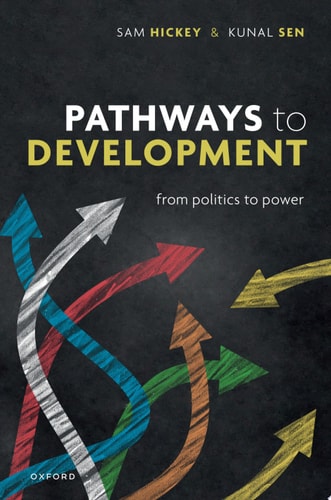
Pathways to Development: From Politics to Power
0
0
As an Amazon Associate and affiliate partner, Menrva Books earns from qualifying purchases. Learn more
Author Description
This is an open access title available under the terms of a CC BY-BC-ND 4.0 International License. It is free to read at Oxford Scholarship Online and offered as a free PDF download from OUP and selected open access locations.The puzzle of why some countries are wealthier and more developed than others continues to confound students and practitioners of development alike. Whereas earlier grand explanations focused on issues of 'geography' or 'institutions', the second decade of the 21st century finally saw 'politics' arrive centre-stage within international development. This catalyzed a search to answer the key question: under what conditions do governments become committed to and capable of delivering development? How can these processes be conceptualized and researched? And what (if anything) can be done to 'get the politics right' for development?Pathways to Development draws on a major comparative research effort to present new answers to the question of how politics shapes development. It develops and applies a 'power domains' framework across multiple countries in the global South to uncover the political drivers of development across a wide range of policy areas, including economic growth, gender equity, health, and education. Hickey and Sen find that a country's pathway to development is shaped less by institutional type than by the nature of the politics and power relations that underpinned these institutions and which shape how they actually function in practice within different policy domains.Comparative analysis reveals two alternative pathways to developmental outcomes, each of which is specific to particular configurations of power. The first involves a dominant ruling coalition with a strong developmental vision that faces an existential threat from social forces; the second involves competitive settlements within which the short-term vision of ruling elites and the politicization of the public bureaucracy are offset by the presence of strong and cohe
Menrva's Summary
THE THESIS
This book investigates the core question of how political power dynamics and ruling coalitions determine a nation's capacity to achieve developmental outcomes. Professors Kunal Sen and Samuel Hickey utilize a comparative research framework to analyze how politics shapes development across the global South. By moving beyond traditional institutional or geographic explanations, the authors argue that the specific configuration of power relations within a country dictates the functionality and success of its policy domains.
THE SCOPE MAP
What You Will Find
- A 'power domains' analytical framework for assessing political drivers of development.
- Comparative case studies across multiple countries in the global South.
- Analysis of policy areas including economic growth, gender equity, health, and education.
- Examination of how ruling coalitions and competitive settlements influence bureaucratic function.
THE AUTHORITY PERSPECTIVE
Experts recognize this work as a significant contribution to the field of development studies for its shift toward political economy. Scholars frequently note the academic rigor of the comparative analysis and its utility for practitioners seeking to understand the intersection of governance and development outcomes.
Page Count:
208
Publication Date:
2024-01-01
Publisher:
Oxford University Press
ISBN-10:
0198872569
ISBN-13:
9780198872566
Economics
International relations
Public Policy
Community Tags
Similar Books