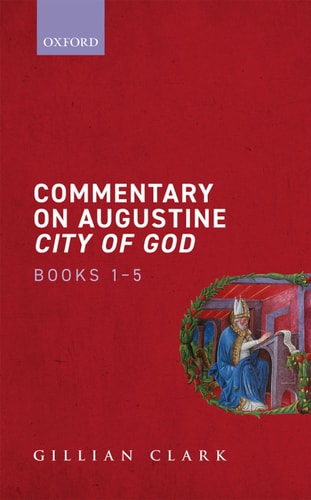
Commentary on Augustine City of God, Books 1-5
0
0
As an Amazon Associate and affiliate partner, Menrva Books earns from qualifying purchases. Learn more
Author Description
Augustine began City of God, De Civitate Dei, to answer complaints that Christians were to blame for the troubles of Rome and its empire because they would not sacrifice to the gods. In August 411 Alaric the Goth led barbarian warriors into the city. Refugees crossed to Africa, Augustine's homeland, where he was bishop of Hippo. This English-language commentary discusses Books 1-5, in which Augustine argued that Rome suffered worse disasters before Christianity was known; that empire depends on injustice; and that everything depends on the will of the true God, not on the many gods of Roman tradition. He had taught classical Latin literature and rhetoric, and used material and techniques which were familiar to educated Romans. He exploited authors they found authoritative: Sallust on Roman history, Cicero on Roman government, Virgil on Rome's imperial mission, the scholar Varro on Roman religious tradition. He discussed power and glory, pleasure and virtue; war and suicide, rape and celibacy; the purpose of suffering; fate and choice. He made a commitment to debate with philosophers on worshipping many gods for the sake of life after death, and to move from refuting false beliefs to expounding Christian teachings on the 'two cities'. The earthly city is the community of all who love themselves rather than God; the city of God is the community of all who love God rather than themselves. City of God took 22 books, which were influential--and often misunderstood--in later centuries.
Menrva's Summary
THE THESIS
This commentary investigates how Augustine of Hippo utilized classical rhetoric and historical precedent to defend Christianity against accusations that it caused the decline of the Roman Empire. Gillian Clark, a scholar of late antiquity, examines the first five books of De Civitate Dei to illustrate how Augustine challenged the Roman reliance on traditional pagan deities. By analyzing Augustine's engagement with authors like Cicero, Sallust, and Virgil, the text demonstrates how he reframed the concept of imperial power and divine providence for an educated Roman audience.
THE SCOPE MAP
What You Will Find
- A detailed analysis of the first five books of Augustine's City of God.
- Examination of Augustine's rhetorical techniques derived from his background in classical Latin literature.
- Discussion of key themes including the nature of justice, the purpose of suffering, and the distinction between the earthly city and the city of God.
- Contextualization of the historical crisis following the sack of Rome by Alaric the Goth in 411 AD.
THE AUTHORITY PERSPECTIVE
Scholars and students of patristic literature frequently highlight this work as a vital resource for understanding the intersection of classical philosophy and early Christian theology. The text is noted for its clarity in navigating Augustine's complex arguments, making it a standard reference for those studying the transition from the Roman world to the medieval period.
Page Count:
304
Publication Date:
2021-10-12
Publisher:
Oxford University Press
ISBN-10:
0198870078
ISBN-13:
9780198870074
History
Religion
Philosophy
Theology
Christianity
Community Tags
Similar Books