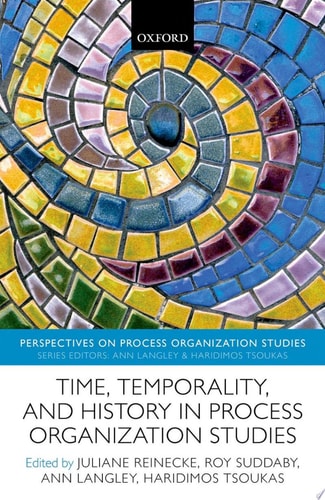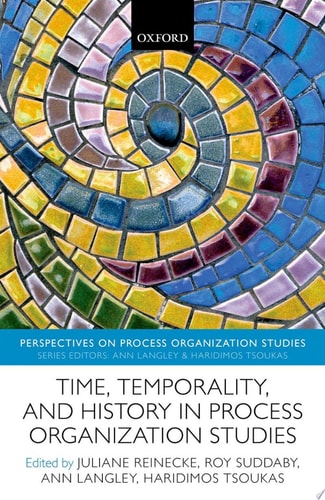
Time, Temporality, and History in Process Organization Studies
0
0
As an Amazon Associate and affiliate partner, Menrva Books earns from qualifying purchases. Learn more
Author Description
Time, timing, and temporality are inherently important to organizational process studies, yet time remains an under-theorized construct that has struggled to move much beyond chronological conceptions of "clock" time. Missing from this linear view are ongoing debates about objectivity versus subjectivity in the experience of time, linear versus alternative structures of time, or an appreciation of collective or culturally determined inferences of temporality. This is critical as our understanding of time and temporality can shape how we view and relate to organizational phenomena, either as unfolding processes or stable objects.History is equally important. While we have an intuitive sense of history as a process, organizational theorists have struggled to move beyond two limited conceptualizations: history as a constraint on organization's capacity for change, or history as a unique source of competitive advantage. Both approaches suffer from the restrictive view of history as an objective set of "brute facts" that are exterior to the individuals, organizations, and collectives that experience them. Yet management theory is acquiring an awareness of time, history, and memory as critical elements in processes of organizing. This volume draws together emerging strands of interest in adopting a more nuanced orientation toward time, temporality, and history to better understand the temporal aspects of organizational processes.
Menrva's Summary
THE THESIS
This volume investigates how organizational scholars can move beyond simplistic, chronological conceptions of time and history to better understand the complex, unfolding nature of organizational processes. The editors, Ann Langley, Haridimos Tsoukas, Juliane Reinecke, and Roy Suddaby, assemble a collection of scholarly contributions that challenge the traditional view of time as a mere clock-based metric and history as a static set of external facts. By integrating diverse theoretical perspectives, the authors argue that temporality and memory are active, constitutive elements that shape how organizations function and evolve over time.
THE SCOPE MAP
What You Will Find
- Theoretical frameworks for distinguishing between objective clock time and subjective temporal experience.
- Methodological approaches for analyzing history as a dynamic process rather than a static constraint.
- Critical discussions on the role of memory and cultural narratives in organizational change.
- Case studies and conceptual models that link temporal awareness to strategic organizational behavior.
THE AUTHORITY PERSPECTIVE
Experts in organizational studies recognize this volume as a significant contribution to the 'process' turn in management theory. Scholars frequently cite the text for its rigorous attempt to bridge the gap between abstract philosophical concepts of time and the practical realities of organizational life.
Page Count:
336
Publication Date:
2021-03-12
Publisher:
Oxford University Press
ISBN-10:
019887071X
ISBN-13:
9780198870715
Philosophy
Business
Management
Organizational Theory
Sociology