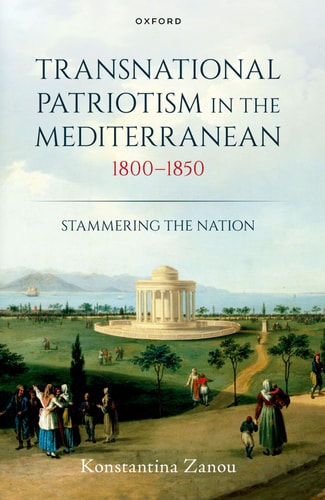
Transnational Patriotism in the Mediterranean, 1800-1850: Stammering the Nation
0
0
As an Amazon Associate and affiliate partner, Menrva Books earns from qualifying purchases. Learn more
Author Description
Winner of the 2020 Mediterranean Seminar Best Book PrizeWinner of the Helen and Howard R. Marraro Prize of the Society for Italian Historical StudiesWinner of the 2019 Edmund Keely Book PrizeTransnational Patriotism in the Mediterranean investigates the long process of transition from a world of empires to a world of nation-states by narrating the biographies of a group of people who were born within empires but came of age surrounded by the emerging vocabulary of nationalism, much of which they themselves created.It is the story of a generation of intellectuals and political thinkers from the Ionian Islands who experienced the collapse of the Republic of Venice and the dissolution of the common cultural and political space of the Adriatic, and who contributed to the creation of Italian and Greek nationalisms. By uncovering this forgotten intellectual universe, Transnational Patriotism in the Mediterranean retrieves a world characterized by multiple cultural, intellectual, and political affiliations that have since been buried by the conventional narrative of the formation of nation-states.Transnational Patriotism in the Mediterranean rethinks the origins of Italian and Greek nationalisms and states, highlighting the intellectual connection between the Italian peninsula, Greece, and Russia, and reestablishing the lost link between the changing geopolitical contexts of western Europe, the Mediterranean, and the Balkans in the Age of Revolutions. It re-inscribes important intellectuals and political figures, considered 'national fathers' of Italy and Greece (such as Ugo Foscolo, Dionysios Solomos, Ioannis Kapodistrias, and Niccolò Tommaseo), into their regional and multicultural context, and shows how nations emerged from an intermingling, rather than a clash, of ideas concerning empire and liberalism, Enlightenment and religion, revolution and conservatism, and East and West.
Menrva's Summary
THE THESIS
This work investigates how the transition from imperial structures to nation-states in the 19th-century Mediterranean was shaped by a specific generation of intellectuals who navigated multiple cultural and political identities. Prof. Konstantina Zanou, a scholar of Mediterranean and Balkan history, utilizes biographical analysis and archival research to argue that Italian and Greek nationalisms were not isolated phenomena but products of a shared, transnational intellectual space. By examining the lives of figures like Ugo Foscolo and Ioannis Kapodistrias, the book demonstrates that the emergence of the nation-state was an iterative process of cultural synthesis rather than a simple rejection of imperial rule.
THE SCOPE MAP
What You Will Find
- A detailed examination of the Ionian Islands as a nexus for intellectual exchange between the Adriatic, Italy, Greece, and Russia.
- Analysis of the collapse of the Republic of Venice and its impact on regional political identity.
- Biographical case studies of key figures including Ugo Foscolo, Dionysios Solomos, and Niccolò Tommaseo.
- A framework for understanding the interplay between Enlightenment ideals, liberalism, and conservative thought during the Age of Revolutions.
THE AUTHORITY PERSPECTIVE
Scholars and historians recognize this text as a significant contribution to the study of transnational intellectual history, particularly for its ability to bridge the gap between Italian and Greek historiography. Readers frequently note the academic density of the prose and the author's meticulous use of primary sources to challenge traditional, state-centric narratives of nationalism.
Page Count:
272
Publication Date:
2023-01-01
Publisher:
Oxford University Press
ISBN-10:
0198885105
ISBN-13:
9780198885108
History
European History
Nationalism
Mediterranean History
Europe
Patriotism
Intellectual History
Community Tags
Similar Books