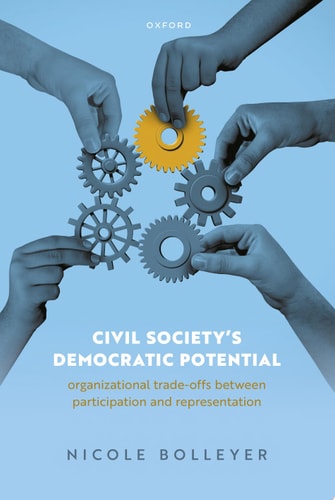
Civil Society's Democratic Potential: Organizational Trade-offs between Participation and Representation
0
0
As an Amazon Associate and affiliate partner, Menrva Books earns from qualifying purchases. Learn more
Author Description
This is an open access title available under the terms of a CC BY-NC-ND 4.0 International licence. It is free to read on the Oxford Academic platform and offered as a free PDF download from OUP and selected open access locations.In Civil Society's Democratic Potential, Nicole Bolleyer explores which civil society organizations (CSOs) contribute to democracy, how, and why.Organized civil society, including interest groups, political parties, and service-oriented associations, is traditionally considered a cornerstone of democracy. Constituting the organizational fabric between government and society, these organizations encompass a wide diversity of entities thought to fundamentally contribute to both democratic participation and representation. However, CSOs' readiness and ability to serve as venues for participation, vehicles of democratic representation, or indeed both at the same time, are increasingly questioned in political science, sociology, and voluntary sector research alike.Bringing those fields together, the author argues that two contrasting organizational templates - the 'voluntary association' and the 'professionalized voluntary organization' - allow theorizing fundamental trade-offs shaping CSOs' 'performance' on three dimensions accounting for their varying democratic contributions: participation, representation, and societal responsiveness. The study's innovative theoretical framework is examined using a mixed-methods design. The latter combines the analysis of survey data covering over 3000 CSOs across four European democracies with qualitative case studies of the evolution of three CSOs - a political party, an interest group, and a service-orientated organization - over several decades.
Menrva's Summary
THE THESIS
This book investigates the conditions under which civil society organizations (CSOs) effectively contribute to democratic processes, specifically focusing on the inherent tensions between participation and representation. Nicole Bolleyer, a scholar in political science, utilizes a comparative framework to evaluate how different organizational structures influence the democratic performance of groups. By contrasting the traditional 'voluntary association' model with the 'professionalized voluntary organization,' the author provides a systematic analysis of how these entities navigate the trade-offs between societal responsiveness and institutional representation.
THE SCOPE MAP
What You Will Find
- A theoretical framework comparing voluntary associations and professionalized voluntary organizations.
- Quantitative analysis of survey data from over 3000 civil society organizations across four European democracies.
- Qualitative longitudinal case studies tracking the evolution of a political party, an interest group, and a service-oriented organization.
- An evaluation of organizational performance across three specific dimensions: participation, representation, and societal responsiveness.
THE AUTHORITY PERSPECTIVE
Experts in political science and sociology recognize this work as a rigorous contribution to the study of organizational behavior within democratic systems. Readers frequently note the academic density of the prose and the systematic nature of the mixed-methods approach employed by the author.
Page Count:
320
Publication Date:
2024-01-01
Publisher:
Oxford University Press
ISBN-10:
0198884397
ISBN-13:
9780198884392
Politics
Democracy
Public Policy
Civil society
Sociology
Systems Theory
Community Tags
Similar Books