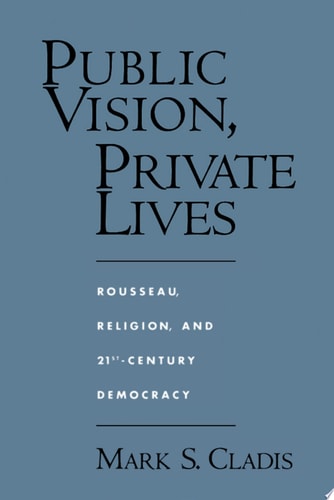
Public Vision, Private Lives: Rousseau, Religion, and 21st-Century Democracy
0
0
As an Amazon Associate and affiliate partner, Menrva Books earns from qualifying purchases. Learn more
Author Description
Listening closely to the religious pitch in Rousseau's voice, Cladis convincingly shows that Rousseau, when attempting to portray the most characteristic aspects of the public and private, reached for a religious vocabulary. Honoring both love of self and love of that which is larger than the self--these twin poles, with all the tension between them--mark Rousseau's work, vision and challenge--the challenge of 21st-century democracy.
Menrva's Summary
THE THESIS
How does the religious vocabulary embedded in Jean-Jacques Rousseau’s political philosophy inform the tensions of modern democratic life? Mark S. Cladis, a scholar of religion and philosophy, examines Rousseau’s work to uncover the interplay between individual self-interest and the collective good. By analyzing Rousseau’s reliance on religious language to articulate public and private spheres, Cladis argues that these historical insights remain critical for navigating the complexities of 21st-century democratic governance.
THE SCOPE MAP
What You Will Find
- Analysis of Rousseau’s primary texts regarding the public and private divide
- Examination of the role of religious vocabulary in secular political theory
- Discussion of the tension between self-love and communal obligation
Scope Limits
- Does not provide a comprehensive biography of Rousseau
- Does not offer a policy-based manual for modern democratic reform
THE AUTHORITY PERSPECTIVE
Scholars and political theorists frequently cite this work for its nuanced interpretation of Rousseau’s often-misunderstood religious rhetoric. Experts highlight the text as a valuable contribution to the ongoing dialogue regarding the intersection of faith and secular democratic institutions.
Page Count:
305
Publication Date:
2003-01-01
Publisher:
Oxford University Press
ISBN-10:
0190284293
ISBN-13:
9780190284299
Philosophy
Religion
Public Policy
Democracy
Religion
Political Philosophy
Community Tags
Similar Books