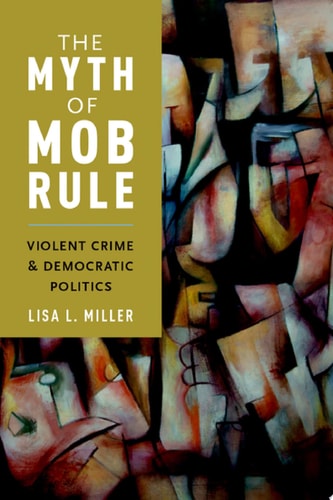
The Myth of Mob Rule: Violent Crime and Democratic Politics
0
0
As an Amazon Associate and affiliate partner, Menrva Books earns from qualifying purchases. Learn more
Author Description
Scholars and lay persons alike routinely express concern about the capacity of democratic publics to respond rationally to emotionally charged issues such as crime, particularly when race and class biases are invoked. This is especially true in the United States, which has the highest imprisonment rate in the developed world, the result, many argue, of too many opportunities for elected officials to be highly responsive to public opinion. Limiting the power of democratic publics, in this view, is an essential component of modern governance precisely because of the risk that broad democratic participation can encourage impulsive, irrational and even murderous demands.These claims about panic-prone mass publics--about the dangers of 'mob rule'--are widespread and are the central focus of Lisa L. Miller's The Myth of Mob Rule. Are democratic majorities easily drawn to crime as a political issue, even when risk of violence is low? Do they support 'rational alternatives' to wholly repressive practices, or are they essentially the bellua multorum capitum, the "many-headed beast," winnowing problems of crime and violence down to inexorably harsh retributive justice? Drawing on a comparative case study of three countries--the U.S., the U.K. and the Netherlands--The Myth of Mob Rule explores when and with what consequences crime becomes a politically salient issue. Using extensive data from multiple sources, the analyses reverses many of the accepted causal claims in the literature and finds that: serious violence is an important underlying condition for sustained public and political attention to crime; the United States has high levels of both crime and punishment in part because it has failed, in racially stratified ways, to produce fundamental collective goods that insulate modern democratic citizens from risk of violence, a consequence of a democratic deficit, not a democratic surplus; and finally, countries with multi-party parliamentary systems are more responsive to
Menrva's Summary
THE THESIS
This work investigates whether democratic publics are inherently prone to irrational, punitive responses to crime, or if the political systems themselves dictate the severity of justice. Lisa L. Miller, a professor of political science, challenges the prevailing assumption that high imprisonment rates result from an over-responsive democratic public. Instead, she argues that the failure to provide collective goods and address systemic inequality creates a democratic deficit that exacerbates crime and subsequent retributive policies.
THE SCOPE MAP
What You Will Find
- Comparative analysis of crime policy in the United States, the United Kingdom, and the Netherlands.
- Quantitative and qualitative data regarding public opinion and political responsiveness to crime.
- A framework for understanding how parliamentary versus presidential systems influence criminal justice outcomes.
Scope Limits
- The analysis does not provide a comprehensive history of global penal systems outside the three focus countries.
- The text does not offer specific legislative policy recommendations for immediate reform.
THE AUTHORITY PERSPECTIVE
Experts recognize this text as a significant contribution to the study of democratic institutions and their influence on criminal justice policy. Readers frequently note the academic density of the prose, which is well-suited for scholars and students of political science and sociology.
Page Count:
259
Publication Date:
2016-01-01
Publisher:
Oxford University Press
ISBN-10:
0190602376
ISBN-13:
9780190602376
Public Policy
Criminology
Democracy
Violent Crimes
Sociology
Comparative Politics
Community Tags
Similar Books