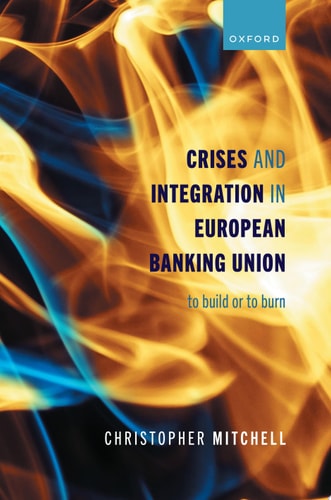
Crises and Integration in European Banking Union: To Build or To Burn
0
0
As an Amazon Associate and affiliate partner, Menrva Books earns from qualifying purchases. Learn more
Author Description
It is conventional wisdom among scholars, policymakers, and other observers that crises are one of the primary drivers of European integration. However, while many crises have indeed spurred deeper integration, there is also no shortage of crises that failed to produce meaningful deepening, or even led to disintegration. The literature on European integration has to date failed to develop a theory to identify ex ante which crises are most likely to produce integrating reform. Crises and Integration in European Banking Union addresses that gap, building a theory of how the combination of crisis severity and origin indicates whether a crisis will produce deep reform, modest reform, or a persistence of the pre-crisis status quo.Mitchell does so by examining the relative impact of a series of crises on the centralization of European financial regulation in the 21st century, including the 2007-09 Banking Crisis, 2010-14 Debt Crisis, the Brexit shock, and the 2020-21 COVID-19 Pandemic. It thus also makes an important contribution to the literature on European financial regulation and the steps needed to complete a European banking and capital markets union. The volume not only addresses a significant theoretical gap, but also provides a foundation for policymaking in response to future crises by building a framework to identify which challenges are most likely to provide an opportunity for deeper integration.
Menrva's Summary
THE THESIS
This book investigates the theoretical conditions under which financial crises serve as catalysts for European integration versus those that result in stagnation or disintegration. Professor Christopher Mitchell utilizes a comparative analysis of 21st-century economic shocks to construct a predictive framework. By evaluating the interplay between crisis severity and origin, the author provides a systematic method for determining the likelihood of deep reform, modest adjustment, or the maintenance of the status quo in European banking regulation.
THE SCOPE MAP
What You Will Find
- A theoretical framework linking crisis characteristics to institutional reform outcomes.
- Analysis of major 21st-century events including the 2007-09 Banking Crisis and the 2010-14 Debt Crisis.
- Examination of the Brexit shock and the 2020-21 COVID-19 Pandemic as drivers of regulatory change.
- Policy-oriented insights regarding the completion of the European banking and capital markets union.
THE AUTHORITY PERSPECTIVE
Experts identify this work as a significant contribution to the literature on European financial regulation and institutional theory. Readers frequently note the clarity of the author's framework, which provides a practical tool for policymakers and scholars to anticipate the political consequences of future economic instability.
Page Count:
384
Publication Date:
2024-01-01
Publisher:
Oxford University Press
ISBN-10:
0198889062
ISBN-13:
9780198889069
Economics
Finance
Public Policy
Banking
Community Tags
Similar Books