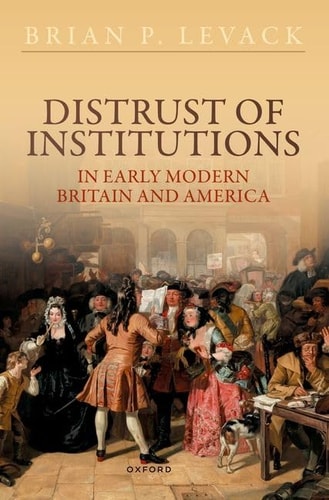
Distrust of Institutions in Early Modern Britain and America
0
0
As an Amazon Associate and affiliate partner, Menrva Books earns from qualifying purchases. Learn more
Author Description
Distrust of public institutions, which reached critical proportions in Britain and the United States in the first two decades of the twenty-first century, was an important theme of public discourse in Britain and colonial America during the early modern period. Demonstrating broad chronological and thematic range, the historian Brian P. Levack explains that trust in public institutions is more tenuous and difficult to restore once it has been betrayed than trust in one's family, friends, and neighbours, because the vast majority of the populace do not personally know the officials who run large national institutions. Institutional distrust shaped the political, legal, economic, and religious history of England, Scotland, and the British colonies in America. It provided a theoretical and rhetorical foundation for the two English revolutions of the seventeenth century and the American Revolution in the late eighteenth century. It also inspired reforms of criminal procedure, changes in the system of public credit and finance, and challenges to the clergy who dominated the Church of England, the Church of Scotland, and the churches in the American colonies. This study reveals striking parallels between the loss of trust in British and American institutions in the early modern period and the present day.
Menrva's Summary
THE THESIS
This work investigates the historical origins and long-term consequences of institutional distrust in Britain and colonial America, questioning why such skepticism remains a persistent feature of public discourse. Brian P. Levack, a distinguished historian of early modern Europe, utilizes a comparative framework to analyze how the erosion of public confidence shaped political, legal, and religious structures. By examining the seventeenth and eighteenth centuries, he argues that the betrayal of institutional trust creates a lasting instability that mirrors contemporary societal challenges. The study provides a rigorous analysis of how this skepticism served as a catalyst for revolutionary movements and systemic reforms across the Atlantic world.
THE SCOPE MAP
What You Will Find
- Analysis of the political, legal, economic, and religious history of England, Scotland, and the American colonies.
- Examination of the theoretical and rhetorical foundations of the seventeenth-century English revolutions and the American Revolution.
- Case studies on the reform of criminal procedure and the evolution of public credit and finance systems.
- Historical investigation into the challenges posed to the clergy and established church hierarchies.
THE AUTHORITY PERSPECTIVE
Experts recognize this study as a significant contribution to the understanding of political culture and the historical roots of modern skepticism. Readers frequently note the clarity of the author's prose and the relevance of his historical parallels to current events.
Page Count:
224
Publication Date:
2024-01-01
Publisher:
Oxford University Press
ISBN-10:
0198886357
ISBN-13:
9780198886358
History
Europe
British History
Public opinion
Institutional Studies
American History
Americas
Community Tags
Similar Books














