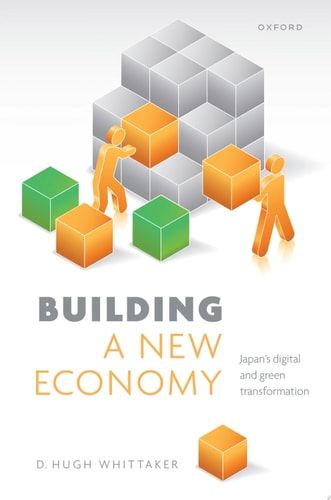
Building a New Economy: Japan's Digital and Green Transformation
0
0
As an Amazon Associate and affiliate partner, Menrva Books earns from qualifying purchases. Learn more
Author Description
Japan is attempting to build a new economy. It goes by various names, such as 'Society 5.0', 'sustainable capitalism', and 'new form of capitalism'. It is to be constructed through digital and green transformation, and a 'virtuous cycle of growth and distribution'. The effort faces strong headwinds, including demographic decline and ageing, Japan's external energy dependence and geopolitical turbulence, and the legacies of Japan's 'lost decades'. Nonetheless, since 2015 a path has been identified that steers between Big Tech market oligopoly on the one hand, and an overbearing state on the other. For others facing the same post-neoliberal, sustainability transformation challenges as Japan, this public-private coordinated building effort is noteworthy.Building a New Economy uses an evolutionary conceptual framework of states-and-markets, organizations-and-technology, and institutional change. It shows how the institutional coherence of the manufacturing-centred postwar model broke down, and was followed by the ideological and institutional dissonance of the 'lost decades'. However, new institutional building blocks have been identified and (partially) assembled which could lead Japan towards a new model which is more open and adaptive. These blocks include a reconfigured developmental state, and new forms of coordination with and within the corporate sector, at times encompassing civil society.Importantly, for a country that has favoured social stability over creative destruction, and has struggled with change, the path forward may require 'controlled dis-equilibrium' of institutions rather than tight coherence. 'Society 5.0' and the 'new form of capitalism' claim to be people-centred; making them so will be the crucial challenge.
Menrva's Summary
THE THESIS
This book investigates whether Japan can successfully transition to a new economic model through digital and green transformation while navigating the constraints of demographic decline and historical institutional legacies. D. Hugh Whittaker, an expert in Japanese political economy, utilizes an evolutionary framework to analyze the shift from the postwar manufacturing-centered model to a contemporary approach characterized by public-private coordination. The author argues that Japan is attempting to forge a unique path that avoids both the pitfalls of Big Tech oligopolies and excessive state control, proposing that 'controlled dis-equilibrium' may be necessary for future growth.
THE SCOPE MAP
What You Will Find
- Analysis of the 'Society 5.0' and 'new form of capitalism' policy frameworks.
- Examination of institutional change within the Japanese corporate sector and state apparatus.
- Assessment of external pressures including energy dependence and geopolitical instability.
- Evaluation of the transition from the postwar model through the 'lost decades' to current reform efforts.
THE AUTHORITY PERSPECTIVE
Scholars and policy analysts view this work as a significant contribution to the study of post-neoliberal economic transitions. Readers frequently note the academic density of the prose, which provides a rigorous examination of Japan's institutional evolution for those interested in comparative political economy.
Page Count:
272
Publication Date:
2024-01-01
Publisher:
Oxford University Press
ISBN-10:
0198893396
ISBN-13:
9780198893394
Politics
Economics
Japan
Economic Policy & Development
Public Policy
Technology
Sustainability
Community Tags
Similar Books