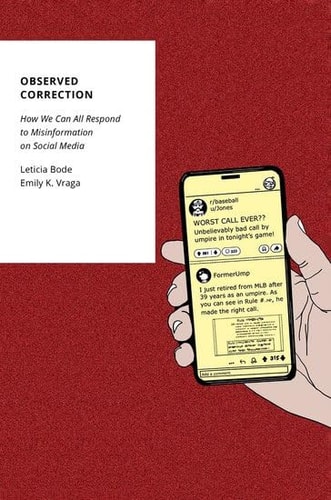
Observed Correction: How We Can All Respond to Misinformation on Social Media
0
0
As an Amazon Associate and affiliate partner, Menrva Books earns from qualifying purchases. Learn more
Author Description
While many solutions have been proposed to combat misinformation on social media, most are either ineffective, expensive, or do not work at scale. What if social media users could help mitigate the misinformation they're also responsible for proliferating?In Observed Correction, Leticia Bode and Emily K. Vraga consider both the power of and the barriers to "observed correction"--users witnessing other users correct misinformation on social media. Bode and Vraga argue that when people view others directly and publicly correct misinformation on social media, their understanding of the topic becomes more accurate. Yet, while many members of the public value correction, Bode and Vraga find that they are often reluctant to correct misinformation they see on social media. This same reluctance to correct is seen among expert fact checkers and health communicators, compounded by the constraints of limited resources and competing priorities. To empower people to respond to misinformation, Bode and Vraga offer a set of practical recommendations for how observational correction can be implemented. In some cases, simple messages addressing concerns can increase users' willingness to respond to misinformation. In other cases, they argue that platforms will need to promote corrections and protect the correctors while experts can contribute by creating accessible curated evidence (ACE) to facilitate user corrections and build social norms around responding to misinformation.Including analysis of eleven experiments, seven surveys, and dozens of interviews with social media users, health professionals, fact checkers, and platform employees about their efforts to curb misinformation online, Bode and Vraga make the case that observed correction is an effective and scalable tool in the fight against bad content on the Internet.
Menrva's Summary
THE THESIS
Can public, peer-to-peer correction of misinformation on social media serve as a scalable and effective mechanism for improving information accuracy? Emily K. Vraga and Leticia Bode, both established scholars in political communication and digital media, investigate the phenomenon of "observed correction." Drawing on a robust dataset of eleven experiments, seven surveys, and extensive interviews with stakeholders ranging from health professionals to platform employees, the authors argue that witnessing corrections can significantly improve user understanding. They propose a framework where individual users, supported by platform design and expert-curated resources, can collectively mitigate the spread of false information.
THE SCOPE MAP
What You Will Find
- Analysis of eleven distinct experiments and seven surveys regarding user behavior on social media.
- Qualitative insights from interviews with health professionals, fact checkers, and platform employees.
- The concept of Accessible Curated Evidence (ACE) as a tool for facilitating user-led corrections.
- Practical recommendations for platforms to promote correction and protect users who engage in fact-checking.
THE AUTHORITY PERSPECTIVE
Experts in digital politics and communication studies identify this work as a significant contribution to the study of online information ecosystems. Readers frequently note the academic rigor of the methodology while appreciating the practical, actionable nature of the authors' recommendations for both platforms and individual users.
Page Count:
272
Publication Date:
2025-06-01
Publisher:
Oxford University Press
ISBN-10:
0197565905
ISBN-13:
9780197565902
Politics
Technology
Communication
Public Policy
Social Media
Elections & Political Process
Sociology
Community Tags
Similar Books