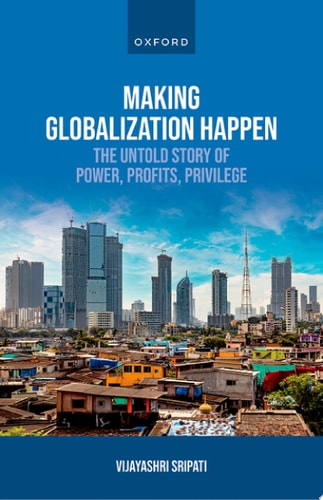
Making Globalization Happen: The Untold Story of Power, Profits, Privilege
0
0
As an Amazon Associate and affiliate partner, Menrva Books earns from qualifying purchases. Learn more
Author Description
In Making Globalization Happen: The Untold Story of Power, Profits, Privilege, Sripati explains how, when, through which entities, and for what purposes economic globalization was catalyzed and its effects on the Global South in general and South Asia in particular. Based on an innovative international constitutional political economy framework, Sripati examines how the Western classical liberal constitution has shaped international law developments in this post-colonial era given its salience and comprehensive scope. Presenting a comprehensive narrative of economic globalization, Making Globalization Happen accurately and comprehensively links constitutional globalization to the following UN family-created agendas: peacebuilding, conflict prevention, human security, protection of civilians, sustainable development, global war on terrorism, women, peace, and security, poverty reduction or market-oriented development, ending conflict-related sexual violence, and justice (climate, criminal, and transitional). Sripati simultaneously provides the missing constitutional foundation for globalization and the fields that it has spawned: global studies and law and political economy. With these ground-breaking insights, Making Globalization Happen: The Untold Story of Power, Profits, Privilege clearly illustrates who drove constitutional globalization and for whose benefit: the UN family and transnational capitalists. Thus, it rips away the facade of UN family-driven peace, justice, human rights, democracy, and development to expose it as a narrative of power, profit, and privilege for transnational capitalists and debt, death, and despair for the Global South.
Menrva's Summary
THE THESIS
This book investigates the mechanisms by which economic globalization was catalyzed and the specific entities that benefit from its implementation at the expense of the Global South. Vijayashri Sripati utilizes an international constitutional political economy framework to analyze how Western classical liberal constitutionalism has influenced international law in the post-colonial era. By linking constitutional globalization to various UN-led agendas, the author argues that these initiatives serve the interests of transnational capitalists rather than the stated goals of human security and sustainable development.
THE SCOPE MAP
What You Will Find
- Analysis of the intersection between international law and Western constitutional frameworks.
- Examination of UN-led agendas including peacebuilding, conflict prevention, and sustainable development.
- Critique of the impact of market-oriented development on the Global South and South Asia.
- Identification of the primary beneficiaries of constitutional globalization as transnational capitalists.
THE AUTHORITY PERSPECTIVE
Scholars in the fields of international law and political economy view this work as a critical intervention in the discourse surrounding global governance. Readers frequently note the dense, analytical nature of the prose as it challenges conventional narratives regarding the UN's role in global development.
Page Count:
504
Publication Date:
2024-01-01
Publisher:
Oxford University Press
ISBN-10:
0198903154
ISBN-13:
9780198903154
Economics
Politics
Sociology
Public Policy
Economic Policy & Development
Globalization
World politics
International Law
Community Tags
Similar Books