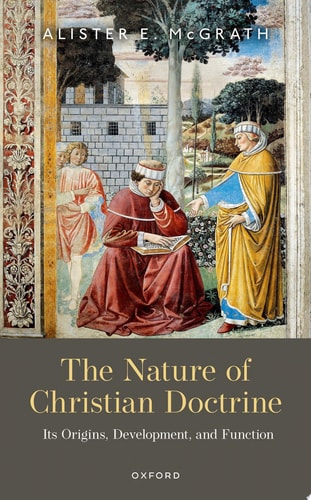
The Nature of Christian Doctrine: Its Origins, Development, and Function
0
0
As an Amazon Associate and affiliate partner, Menrva Books earns from qualifying purchases. Learn more
Author Description
A groundbreaking account of the origins, development, and enduring significance of Christian doctrine, explaining why it remains essential to the life of Christian communities.Noting important parallels between the development of scientific theories and Christian doctrine, Alister E. McGrath examines the growing view of early Christianity as a 'theological laboratory'. We can think of doctrinal formulations as proposals submitted for testing across the Christian world, rather than as static accounts of orthodoxy. This approach fits the available evidence much better than theories of suppressed early orthodoxies and reinforces the importance of debate within the churches as a vital means of testing doctrinal formulations.McGrath offers a robust critique of George Lindbeck's still-influential Nature of Doctrine (1984), raising significant concerns about its reductionist approach. He instead provides a more reliable account of the myriad functions of doctrine, utilising Mary Midgley's concept of 'mapping' as a means of coordinating the multiple aspects of complex phenomena. McGrath's approach also employs Karl Popper's 'Three Worlds', allowing the theoretical, objective, and subjective aspects of doctrine to be seen as essential and interconnected.We see how Christian doctrine offers ontological disclosure about the nature of reality, while at the same time providing a coordinating framework which ensures that its various aspects are seen as parts of a greater whole. Doctrine provides a framework, or standpoint, that allows theological reality to be seen and experienced in a new manner; it safeguards and articulates the core vision of reality that is essential for the proper functioning and future flourishing of Christian communities.
Menrva's Summary
THE THESIS
This work investigates the origins, development, and function of Christian doctrine, questioning how these formulations maintain their significance within contemporary religious communities. Alister E. McGrath, a prominent theologian and scholar, utilizes a framework that draws parallels between the evolution of scientific theories and the development of theological thought. By rejecting static models of orthodoxy, he argues that doctrine functions as a dynamic, testable proposal that coordinates the complex reality of the Christian faith.
THE SCOPE MAP
What You Will Find
- A comparative analysis between the development of scientific theories and Christian doctrinal formulations.
- A critique of George Lindbeck's reductionist approach to the nature of doctrine.
- The application of Mary Midgley’s concept of mapping to coordinate complex theological phenomena.
- The integration of Karl Popper’s 'Three Worlds' theory to analyze the theoretical, objective, and subjective aspects of faith.
THE AUTHORITY PERSPECTIVE
Scholars and theologians frequently cite this text as a sophisticated response to post-liberal approaches in modern theology. Experts highlight the book's utility in bridging the gap between historical development and the practical, ontological function of doctrine in the life of the church.
Page Count:
224
Publication Date:
2024-01-01
Publisher:
Oxford University Press
ISBN-10:
0198901445
ISBN-13:
9780198901440
Religion
Theology
Theology doctrinal
Théologie
Christian Theology
Church Leadership
Church History
Community Tags
Other Editions(2)

Similar Books