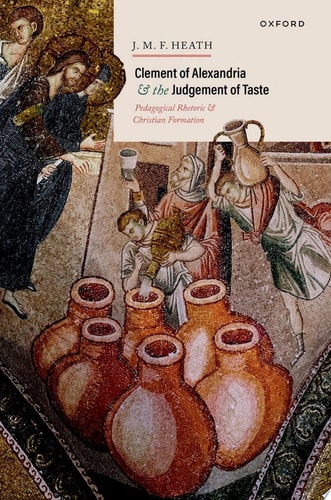
Clement of Alexandria and the Judgement of Taste: Pedagogical Rhetoric and Christian Formation
0
0
As an Amazon Associate and affiliate partner, Menrva Books earns from qualifying purchases. Learn more
Author Description
Clement of Alexandria and the Judgement of Taste: Pedagogical Rhetoric and Christian Formation provides a new account of Clement of Alexandria's Paedagogus as a programme in the formation of the judgement of taste, situating it in critical dialogue with modern approaches to the judgement of taste and aesthetics. The book's key questions are framed in light of Pierre Bourdieu's Distinction (1979): a landmark in twentieth-century scholarship on the theory of taste. J. M. F. Heath studies Clement's rhetoric and theology in the context of the Christian Second Sophistic, when Christians were experimenting with new ways of inhabiting the rhetorical and philosophical culture of the Greco-Roman world. The Paedagogus shows Clement's pedagogical method and rhetorical strategy at the early stages of Christian formation when his audience are not yet ready for abstract philosophical argument. This was a time for forming people's habits of judgement and preferences of 'taste', so as to ground their daily lives in deeper desires and aversions that are structured through a relationship with God.This was an immensely important stage of Christian formation: many people never got beyond this to any sort of philosophical curriculum, and yet, through engaging the 'tastes' of a wide audience, Christian leaders sought to spread the gospel--and succeeded in doing so. Even for the intellectual elites, personal formation through preferences of taste was part of how they embodied their desire for God, and the way they inhabited it through the sacramental and ascetic life of the church. Bourdieu's sociological and anthropological approach proves fruitful for understanding aspects of Clement's rhetorical method and purpose, but the study of Clement's theological rhetoric in its cultural context also, in turn, points the way to a theological response to Bourdieu's theory of taste.
Menrva's Summary
THE THESIS
How does Clement of Alexandria utilize pedagogical rhetoric to shape the aesthetic and moral judgement of early Christians? J. M. F. Heath, a scholar of early Christian history and rhetoric, examines the Paedagogus as a deliberate program for habituating believers into a specific Christian lifestyle. By applying Pierre Bourdieu’s sociological framework of taste to the cultural context of the Second Sophistic, the author argues that Clement’s rhetorical strategies were essential for grounding daily life in divine desire rather than abstract philosophical discourse.
THE SCOPE MAP
What You Will Find
- Analysis of the Paedagogus as a foundational text for early Christian formation.
- Application of Pierre Bourdieu’s sociological theories of taste to ancient rhetorical practices.
- Examination of the Christian Second Sophistic and its interaction with Greco-Roman culture.
- Exploration of how aesthetic preferences and daily habits serve as conduits for theological embodiment.
THE AUTHORITY PERSPECTIVE
Scholars recognize this work as a significant contribution to the intersection of patristic theology and sociological theory. Readers frequently note the academic density of the prose, which serves as a rigorous examination of how early Christian leaders successfully navigated the cultural landscape of the ancient world.
Page Count:
256
Publication Date:
2024-01-01
Publisher:
Oxford University Press
ISBN-10:
0198902018
ISBN-13:
9780198902010
Politics
Philosophy
History
Theology
Church Leadership
Church History
Sociology
Christianity
Rhetoric
Community Tags
Similar Books