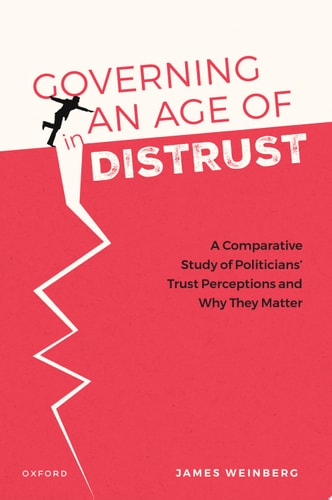
Governing in an Age of Distrust: A Comparative Study of Politicians' Trust Perceptions and Why They Matter
0
0
As an Amazon Associate and affiliate partner, Menrva Books earns from qualifying purchases. Learn more
Author Description
Despite the existence of a large literature on themes relating to trust and distrust in politics, there has been no sustained research that directly engages with the primary objects of trust: politicians. This is an intriguing blind spot in political science that leaves us without any understanding of how politicians appraise a contemporary climate of extreme or generalised distrust or indeed how the existence of a low-trust/high-blame environment affects their decision-making and the quality of public governance.Governing in an Age of Distrust tackles this important gap head on by asking not only whether the public trusts in politicians, but also whether politicians accurately perceive and act upon the trust placed in them. In doing so, Weinberg draws on unique survey and interview data gathered from nationally and locally elected politicians in different countries that have faced a crisis of political trust in recent decades - principally the United Kingdom, Canada, and South Africa. The work identifies different types of 'political trustees' and subsequently analyses the relationship between perceptions of trust and a variety of outcomes such as politicians' blame avoidance behaviour and personal wellbeing. Taking a new and innovative approach to research on trust and elite political behaviour, the author tackles questions that are arguably of paramount importance if we are to understand when, why, and how politicians do or do not deliver on the promise of democracy.
Menrva's Summary
THE THESIS
How do politicians perceive public distrust, and what are the consequences of these perceptions for democratic governance and decision-making? Dr. James Weinberg, a political scientist, addresses a significant gap in existing literature by shifting the focus from public trust to the internal perceptions of elected officials. Utilizing a comparative framework, the author examines how politicians in the United Kingdom, Canada, and South Africa interpret the current climate of political skepticism and how these interpretations influence their professional behavior and personal well-being.
THE SCOPE MAP
What You Will Find
- Comparative analysis of political trust perceptions across the United Kingdom, Canada, and South Africa.
- Empirical data derived from original surveys and interviews with nationally and locally elected politicians.
- A typology of political trustees based on their reactions to low-trust environments.
- Examination of the correlation between perceived distrust and behaviors such as blame avoidance and personal stress.
THE AUTHORITY PERSPECTIVE
Experts identify this work as a significant contribution to political science for its focus on elite-level perceptions rather than public opinion alone. Readers frequently note the academic rigor of the comparative methodology and the clarity with which the author connects psychological perceptions to tangible governance outcomes.
Page Count:
208
Publication Date:
2024-01-01
Publisher:
Oxford University Press
ISBN-10:
0198900740
ISBN-13:
9780198900740
Philosophy
Politics
Public Policy
Systems Theory
Sociology
Elections & Political Process
Governance
Political Psychology
Community Tags
Similar Books