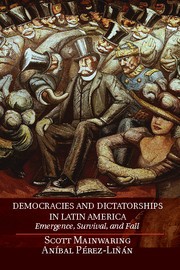
Democracies and Dictatorships in Latin America: Emergence, Survival, and Fall
0
0
As an Amazon Associate and affiliate partner, Menrva Books earns from qualifying purchases. Learn more
Author Description
This book presents a new theory for why political regimes emerge, and why they subsequently survive or break down. It then analyzes the emergence, survival, and fall of democracies and dictatorships in Latin America since 1900. Scott Mainwaring and Aníbal Pérez-Liñán argue for a theoretical approach situated between long-term structural and cultural explanations and short-term explanations that look at the decisions of specific leaders. They focus on the political preferences of powerful actors - the degree to which they embrace democracy as an intrinsically desirable end and their policy radicalism - to explain regime outcomes. They also demonstrate that transnational forces and influences are crucial to understand regional waves of democratization. Based on extensive research into the political histories of all twenty Latin American countries, this book offers the first extended analysis of regime emergence, survival, and failure for all of Latin America over a long period of time
Menrva's Summary
THE THESIS
This book posits a novel theory explaining the emergence, survival, and fall of political regimes, focusing on the political preferences of powerful actors and transnational influences. The authors, Scott Mainwaring and Aníbal Pérez-Liñán, develop an approach that bridges structural and short-term explanations by examining the extent to which key figures embrace democracy and their policy radicalism. Their extensive research covers all twenty Latin American countries from 1900 to the present, providing the first comprehensive analysis of regime dynamics across the region over an extended historical period.
THE SCOPE MAP
- A new theoretical framework for understanding regime emergence, survival, and breakdown.
- Analysis of the historical trajectories of democracies and dictatorships in all twenty Latin American countries since 1900.
- Examination of the role of political preferences, specifically the embrace of democracy and policy radicalism, among powerful actors.
- Exploration of the impact of transnational forces and influences on regional democratization waves.
- A synthesis of long-term structural factors and short-term leadership decisions in explaining regime outcomes.
THE AUTHORITY PERSPECTIVE
The book offers a significant contribution to the study of political regimes in Latin America, presenting a nuanced theoretical framework that moves beyond purely structural or individual-level explanations. Its comprehensive scope, covering all twenty countries over more than a century, provides a rich empirical basis for its arguments. The authors' focus on the political preferences of key actors and the influence of transnational forces offers a compelling perspective on why democracies emerge, persist, or collapse in the region. This work is likely to be of interest to scholars and students of comparative politics, Latin American studies, and democratization.
Page Count:
353
Publication Date:
2013-01-01
ISBN-10:
0521190010
ISBN-13:
9780521190015
Politics
Science
Non-Fiction
History
Democracy
Dictatorship
Regime Change
Community Tags
Similar Books