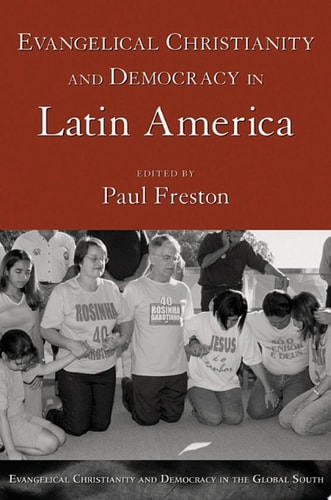
Evangelical Christianity and Democracy in Latin America
0
0
As an Amazon Associate and affiliate partner, Menrva Books earns from qualifying purchases. Learn more
Author Description
In Latin America, evangelical Protestantism poses an increasing challenge to Catholicism's long-established religious hegemony. At the same time, the region is among the most generally democratic outside the West, despite often being labeled as 'underdeveloped.' Scholars disagree whether Latin American Protestantism, as a fast-growing and predominantly lower-class phenomenon, will encourage a political culture that is repressive and authoritarian, or if it will have democratizing effects. Drawing from a range of sources, Evangelical Christianity and Democracy in Latin America provides case studies of five countries: Brazil, Peru, Mexico, Guatemala, and Nicaragua. The contributors, mainly scholars based in Latin America, bring first hand-knowledge to their chapters. The result is a work that explores the relationship between Latin American evangelicalism and politics, its influences, manifestations, and prospects for the future. Evangelical Christianity and Democracy in Latin America is one of four volumes in the series Evangelical Christianity and Democracy in the Global South, which seeks to answer the question: What happens when a revivalist religion based on scriptural orthodoxy participates in the volatile politics of the Third World? At a time when the global-political impact of another revivalist and scriptural religion - Islam - fuels vexed debate among analysts the world over, these volumes offer an unusual comparative perspective on a critical issue: the often combustible interaction of resurgent religion and the developing world's unstable politics.
Menrva's Summary
THE THESIS
This volume investigates whether the rapid growth of evangelical Protestantism in Latin America functions as a catalyst for democratic development or a force for authoritarianism. Paul Freston, a scholar specializing in the sociology of religion, compiles research from regional experts to examine how scriptural orthodoxy intersects with the volatile political landscapes of the developing world. The work challenges simplistic assumptions about the political leanings of lower-class religious movements by analyzing the diverse manifestations of evangelicalism across five distinct national contexts.
THE SCOPE MAP
What You Will Find
- Comparative analysis of evangelical political influence in Brazil, Peru, Mexico, Guatemala, and Nicaragua.
- Examination of the tension between religious hegemony and emerging political pluralism.
- Theoretical frameworks regarding the role of revivalist religion in non-Western democratic systems.
Scope Limits
- The text does not provide an exhaustive survey of every Latin American nation, focusing instead on five specific case studies.
- The analysis does not attempt to predict future political outcomes with certainty, but rather maps current trends and historical influences.
THE AUTHORITY PERSPECTIVE
Experts recognize this volume as a foundational comparative study for understanding the intersection of religion and politics in the Global South. Readers frequently note the academic density of the prose and the value of the contributors' localized, first-hand knowledge of their respective regions.
Page Count:
281
Publication Date:
2008-01-01
Publisher:
Oxford University Press
ISBN-10:
0190291826
ISBN-13:
9780190291822
Politics
History
Religion
Democracy
Sociology
Christianity
Religious Aspects
American History
American Studies
Community Tags
Other Editions(3)
Similar Books






Reader Comments
Share Your Thoughts
No comments yet. Be the first to share your thoughts!