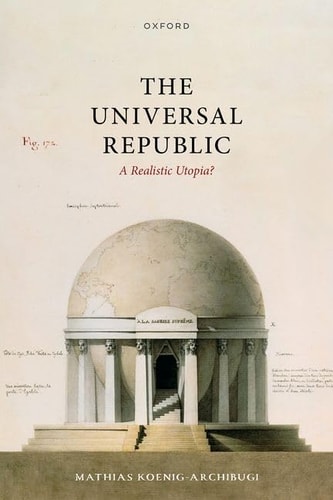
The Universal Republic: A Realistic Utopia?
0
0
As an Amazon Associate and affiliate partner, Menrva Books earns from qualifying purchases. Learn more
Author Description
Can humanity achieve collective self-government in a highly interdependent world? Catastrophic climate change, biodiversity loss, pandemics, war and displacement, the dangers of nuclear weapons and new technologies, and persistent poverty and inequality are among the global challenges that expose the weaknesses of existing international institutions as well as the profound disparities of power and vulnerability that exist among the world's people.The Universal Republic: A Realistic Utopia? examines whether a democratic world state is a feasible and desirable solution to the problem of establishing effective and just governance on the planet we share. While this question has haunted thinkers and doers for centuries, this book opens up novel perspectives by putting the powerful methods and rich data of contemporary social science into the service of a systematic analysis of several key dimensions of the broader theme. The first part of the book shows why a democratic world state -a universal republic- is possible: why it can be achieved, and how it can endure without generating a frightful global despotism. The second part of the book shows why the universal republic is desirable, by exploring how it can help bring under our collective control the persistent sources of coercion, harm, and other processes that affect us deeply across national borders. By combining insights from political philosophy and empirical political science, this work sheds new light on a crucial question of our time: how to bring about a more democratic world.
Menrva's Summary
THE THESIS
Can humanity achieve collective self-government in a highly interdependent world? Mathias Koenig-Archibugi utilizes contemporary social science methods and political philosophy to evaluate the feasibility and desirability of a democratic world state. The author systematically analyzes the structural requirements for global governance, arguing that a universal republic could address systemic challenges like climate change and inequality without devolving into global despotism.
THE SCOPE MAP
What You Will Find
- Analysis of the structural conditions required for a stable, democratic world state.
- Evaluation of global governance mechanisms to mitigate climate change, pandemics, and nuclear proliferation.
- Integration of empirical political science data with classical political philosophy.
- Exploration of the tension between national sovereignty and collective global self-determination.
THE AUTHORITY PERSPECTIVE
Experts recognize this work as a rigorous contribution to the debate on global institutional reform. Readers frequently note the academic density of the prose, which balances theoretical inquiry with practical political analysis.
Page Count:
272
Publication Date:
2024-10-18
Publisher:
Oxford University Press
ISBN-10:
0198921128
ISBN-13:
9780198921127
Politics
World politics
International relations
Democracy
Political Philosophy
Community Tags
Similar Books