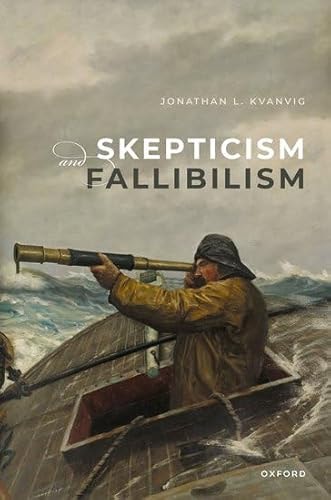
Skepticism and Fallibilism
0
0
As an Amazon Associate and affiliate partner, Menrva Books earns from qualifying purchases. Learn more
Author Description
There Are Two Common Responses To Skepticism, The Epistemological Claim That Knowledge Is At Least Non-existent And Perhaps Also Unachievable, And Both Are To Be Avoided. So I Argue Here. The First Response Is To Succumb To It, Trying Then To Find Some Adequate Basis For Life That Foregoes Presumptions Of Knowledge. The Second Response Is Dismissive, Viewing It As An Overwrought, Hyperbolic Response To Human Limitations, So Wrongheaded That Nothing Beyond A Laconic Response Is Needed Before Returning To Important Philosophical Tasks. Avoiding These Responses Requires Theory Development On The Part Of Skepticism And A Way Of Characterizing Sensitive Fallibilism In Contrast To Complacent Versions Of It. These Two Tasks Take Up The Majority Of The Chapters, Several Of Which Show How Theory Development On Behalf Of The Skeptic Needs To Proceed. The Hardest Part Of This Project Is To Characterize The Skeptical Ideal For Matters That We Investigate Through The Use Of Defeasible Reasoning, Where The Idea Of Finding An Infallibilist Standard Looks Impossible. In Spite Of This Appearance, It Is Possible To Characterize This Ideal In Terms Of Reasoning That Puts One In Full Control Over The Possibility Of Error. The Other Task Involves Characterizing Fallibilism In Terms Of This Notion Of Full Control Over The Possibilities Of Error, And Then Developing A Version Of This View That Doesn't Require Such Full Control While At The Same Time Acknowledging, Predicting, And Explaining How And Why Such Full Control Appears Whenever The Language Of Knowledge Is Used. The Result Is An Approximationist Version Of Fallibilism That Acknowledges That Our Knowledge Is Never Ideal But Is Nonetheless Close Enough To The Ideal To Be Present
Menrva's Summary
THE THESIS
How can one navigate the tension between skeptical challenges to knowledge and the practical necessity of fallibilism? Jonathan L. Kvanvig, a prominent philosopher, examines the failure of both total surrender to skepticism and the dismissive rejection of skeptical arguments. He proposes an approximationist version of fallibilism that accounts for human error while maintaining a rigorous standard for what constitutes knowledge in a world of defeasible reasoning.
THE SCOPE MAP
What You Will Find
- A critical analysis of traditional responses to epistemological skepticism.
- A theoretical framework for understanding the skeptical ideal in the context of defeasible reasoning.
- The development of an approximationist model of fallibilism based on the concept of full control over error.
- An explanation of why the language of knowledge often erroneously implies an infallibilist standard.
THE AUTHORITY PERSPECTIVE
Experts in epistemology recognize this work as a sophisticated contribution to the ongoing debate regarding the limits of human knowledge. Readers frequently note the academic density of the prose, which requires a strong background in analytic philosophy to fully grasp the nuances of Kvanvig's arguments.
Page Count:
208
Publication Date:
2025-03-26
Publisher:
Oxford University Press
ISBN-10:
0198924798
ISBN-13:
9780198924791
Non-Fiction
Politics
Philosophy
Consciousness & Thought
Epistemology
History & Schools of Thought
Logic
Community Tags
Other Editions(2)

Similar Books