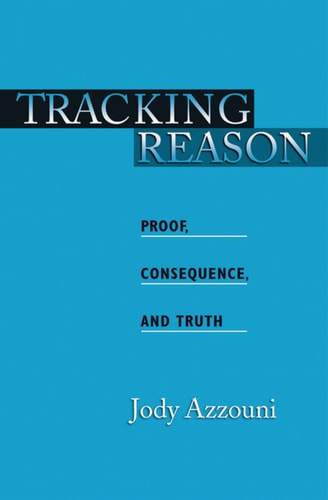
Tracking Reason: Proof, Consequence, and Truth
0
0
As an Amazon Associate and affiliate partner, Menrva Books earns from qualifying purchases. Learn more
Author Description
When ordinary people--mathematicians among them--take something to follow (deductively) from something else, they are exposing the backbone of our self-ascribed ability to reason. Jody Azzouni investigates the connection between that ordinary notion of consequence and the formal analogues invented by logicians. One claim of the book is that, despite our apparent intuitive grasp of consequence, we do not introspect rules by which we reason, nor do we grasp the scope and range of the domain, as it were, of our reasoning. This point is illustrated with a close analysis of a paradigmatic case of ordinary reasoning: mathematical proof.
Menrva's Summary
THE THESIS
How do the intuitive, everyday notions of logical consequence align with the formal systems constructed by logicians? Jody Azzouni, a professor of philosophy, examines the gap between our natural capacity for deductive reasoning and the abstract logical frameworks designed to model it. He argues that humans do not possess introspective access to the internal rules governing their own reasoning processes, using the structure of mathematical proof as a primary case study to demonstrate the limitations of our intuitive grasp of logical scope.
THE SCOPE MAP
What You Will Find
- Analysis of the relationship between informal reasoning and formal logic
- Examination of mathematical proof as a paradigm for deductive thought
- Critique of the assumption that humans introspectively understand their own logical rules
Scope Limits
- Does not provide a comprehensive history of formal logic systems
- Does not offer a psychological manual for improving personal reasoning skills
THE AUTHORITY PERSPECTIVE
Scholars and philosophers frequently cite this work for its rigorous challenge to standard assumptions regarding the transparency of human reasoning. Readers often note the academic density of the prose, which requires a strong background in logic and philosophy to fully synthesize the author's arguments.
Page Count:
254
Publication Date:
2005-01-01
Publisher:
Oxford University Press
ISBN-10:
0190293144
ISBN-13:
9780190293147
Philosophy
Mathematics
Mind & Body
Post-Calculus
Logic & Critical Reasoning
Proof Theory
Mathematics Statistics
Epistemology
Logic
Community Tags
Similar Books