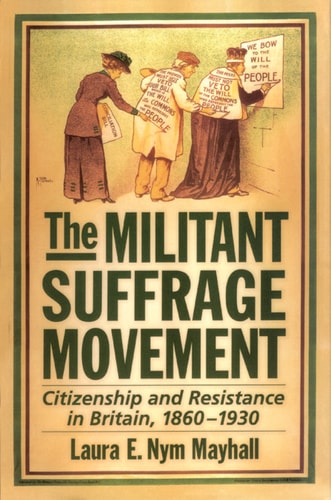
The Militant Suffrage Movement: Citizenship and Resistance in Britain, 1860-1930
0
0
As an Amazon Associate and affiliate partner, Menrva Books earns from qualifying purchases. Learn more
Author Description
The image of middle-class women chaining themselves to the rails of 10 Downing Street, smashing windows of public buildings, and going on hunger strikes in the cause of "votes for women" have become visually synonymous with the British suffragette movement over the past century. Their story has become a defining moment in feminist history, in effect separating women's fight for voting rights from contemporary issues in British political history and disconnecting their militancy from other forms of political activism in Britain in the 19th and early 20th centuries.Drawing upon private papers, pamphlets, newspapers, and the records of a range of suffrage and political organizations, Laura E. Nym Mayhall examines militancy as both a political idea and a set of practices that suffragettes employed to challenge their exclusion from the political nation. She traces the development of the suffragettes' concept of resistance from its origins within radical liberal discourse in the 1860s, to its emergence as political practice during Britain's involvement in the South African War, its reliance on dramatic spectacle by suffragette organizations, and its memorialization following enfranchisement. She reads closely the language and tactics militants used, analyzing their challenges in the courtroom, on the street, and through legislation as reasoned actions of female citizens. The differences in strategy among militants are highlighted, not just in the use of violence, but also in their acceptance and rejection of the authority of the law and their definitions of the ideal relationship between individuals and the state. Variations in the nature of protest continued even during World War I, when most suffragettes suspended their activities to serve the nation's war effort, while others joined peace movements, opposed the state's reduction of civil liberties in wartime, and continued the struggle for suffrage.Mayhall's revealing account of the militant suffrage movement sheds new
Menrva's Summary
THE THESIS
This work investigates how the militant tactics of the British suffrage movement functioned as a deliberate political strategy to redefine female citizenship and challenge the state's exclusionary practices. Laura E. Nym Mayhall, a historian specializing in British political history, utilizes a wide array of primary sources—including private papers, pamphlets, and organizational records—to argue that suffragette militancy was a reasoned, evolving political practice rather than a series of isolated, irrational acts. By situating these actions within the broader context of 19th and early 20th-century British political culture, she demonstrates how activists negotiated their relationship with the law and the state to demand inclusion in the political nation.
THE SCOPE MAP
What You Will Find
- Analysis of radical liberal discourse from the 1860s through the post-enfranchisement era.
- Examination of political tactics including hunger strikes, property damage, and courtroom challenges.
- Comparative study of suffrage strategies during the South African War and World War I.
Scope Limits
- The text focuses specifically on the British context and does not provide a comparative analysis of suffrage movements in other nations.
- The study prioritizes the political and ideological framework of militancy over a comprehensive biographical history of individual suffragette leaders.
THE AUTHORITY PERSPECTIVE
Scholars and historians recognize this text as a significant contribution to the study of political activism and gendered citizenship in Britain. Readers frequently note the academic rigor of the prose and the author's success in contextualizing suffragette tactics within the wider landscape of British political history.
Page Count:
232
Publication Date:
2003-01-01
Publisher:
Oxford University Press
ISBN-10:
0190289481
ISBN-13:
9780190289485
History
Womens rights
Great Britain
Feminism
Womens Studies
European History
British History
Community Tags
Similar Books