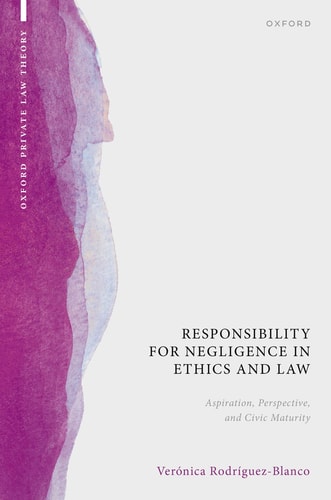
Responsibility for Negligence in Ethics and Law: Aspiration, Perspective, and Civic Maturity
0
0
As an Amazon Associate and affiliate partner, Menrva Books earns from qualifying purchases. Learn more
Author Description
Negligent or inadvertent action in both law and ethics is a matter of agency. The pre-theoretical and philosophical views agree that we are responsible for things that we do intentionally, but it is less clear whether we are responsible for inadvertent or negligent actions. The law of negligence in tort law attributes responsibility for inadvertent acts, while in ethics there is deep and serious scepticism about the responsibility for negligent orinadvertent action. How can we be responsible for things that happen beyond the realm of our knowledge or control?Positioned at the intersection of law and ethics, Responsibility for Negligence in Ethics and Law: Aspiration, Perspective and Civic Maturity responds to these fundamental questions by advancing the idea that the underpinning feature of negligent or inadvertent acts is the phenomenon of akrasia - the lack of integration of character and intelligent thinking. When we act akratically, we are acting contrary to our deliberated intention, due to an uneven development of character and thoughts about what is right, dutiful, and good. Using an Aristotelian-inspired model of deliberation, the book illustrates how legal decisions in negligence invite citizens to adopt a deliberative-aspirational perspective. This perspective encourages them to reshape, redescribe, and rethink their duties of care to meet the aspirational standard of the reasonable person. Consequently, the book argues that the purpose of negligence law is to promote values of citizen engagement and civic maturity.Combining tort law theory, Aristotelian conceptions of deliberation, and theories of practical rationality, responsibility, and action, this book invites us to rethink private law's purpose and methodology.
Menrva's Summary
THE THESIS
How can individuals be held morally and legally responsible for negligent or inadvertent actions that occur outside the scope of their immediate knowledge or control? Verónica Rodríguez-Blanco, a scholar in legal theory, investigates the intersection of tort law and ethical philosophy to address the problem of responsibility for non-intentional harm. By utilizing an Aristotelian framework of deliberation, the author argues that negligence stems from akrasia—a failure to integrate character with intelligent reasoning—and posits that the law serves to foster civic maturity by encouraging citizens to adopt an aspirational perspective toward their duties of care.
THE SCOPE MAP
What You Will Find
- An analysis of the relationship between agency, character, and practical rationality in the context of inadvertent harm.
- A detailed application of Aristotelian deliberation models to modern tort law principles.
- A theoretical framework connecting private law methodology to the promotion of civic engagement.
- An examination of the 'reasonable person' standard as an aspirational goal for individual conduct.
THE AUTHORITY PERSPECTIVE
Legal scholars and philosophers recognize this work as a rigorous contribution to private law theory that bridges the gap between moral philosophy and tort doctrine. Experts frequently highlight the text's dense, academic prose and its sophisticated synthesis of classical ethics with contemporary legal practice.
Page Count:
288
Publication Date:
2025-08-06
Publisher:
Oxford University Press
ISBN-10:
0198948182
ISBN-13:
9780198948186
Politics
Philosophy
Torts
Legal Theory
Tort Law
Ethics
Law
Systems Theory
Jurisprudence
Ethics & Morality
Community Tags
Similar Books