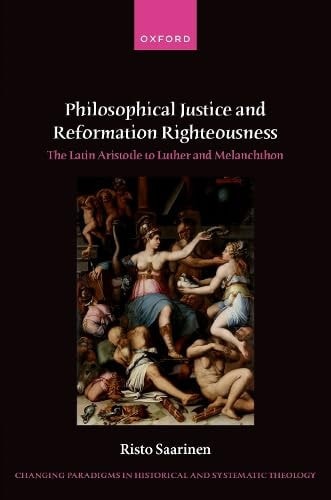
Philosophical Justice and Reformation Righteousness: The Latin Aristotle to Luther and Melanchthon
0
0
As an Amazon Associate and affiliate partner, Menrva Books earns from qualifying purchases. Learn more
Author Description
The churches of the Reformation highlight the righteousness of faith (Iustitia Dei) as the core of their theology. Martin Luther formulated this doctrine as an alternative to the Aristotelian virtue of justice. This volume shows, however, that many different versions of philosophical justice circulated in Luther's days. Some of them already affirm the relational features that characterize later Reformation theology.As Protestant scholarship has not attended to the philosophical commentaries on Aristotle and the formative impact of Anselm and John Duns Scotus in philosophy and theology, the medieval background of imputative and forensic righteousness is much broader than earlier studies assume. This volume argues that a new historical paradigm of Iustitia Dei can be outlined by investigating the complex interaction between Anselmian and Aristotelian thought available in late medieval and Renaissance commentaries.The philosophical trajectory of justice underwent a profound transformation before the sixteenth century. While Thomas Aquinas considers that 'the just' is the object of justice, later scholastic commentators affirm an increasingly subjective and voluntary constitution of justice. In Franciscan thinking, this development leads to a view in which the interplay between the lord and the subjects defines the realm of justice. On the one hand, this interplay is connected to biblical views and the teaching of Anselm. On the other, it permeates the early modern considerations of justice. Therefore, the new paradigm outlined in this study influences both Reformation theology and the broader intellectual history of justice in Western thought.
Menrva's Summary
THE THESIS
This volume investigates the historical and philosophical origins of the Reformation doctrine of righteousness (Iustitia Dei) by examining its complex relationship with medieval Aristotelianism and scholastic thought. Risto Saarinen, a scholar of systematic theology, challenges the traditional view that Luther’s doctrine of righteousness emerged solely as a reaction against Aristotelian virtue. By analyzing late medieval and Renaissance commentaries, the author argues that the concept of justice underwent a significant transformation through the influence of Anselm, John Duns Scotus, and various scholastic thinkers, creating a broader intellectual foundation for Protestant theology than previously recognized.
THE SCOPE MAP
What You Will Find
- An analysis of the transition from objective to subjective and voluntary definitions of justice in scholastic philosophy.
- A detailed examination of the influence of Anselm and John Duns Scotus on the development of imputative and forensic righteousness.
- A comparative study of Aristotelian commentaries circulating during the late medieval and Renaissance periods.
- A new historical paradigm for understanding the interplay between biblical teaching and philosophical justice in Western thought.
THE AUTHORITY PERSPECTIVE
Scholars in the field of Reformation studies identify this work as a significant contribution to the intellectual history of the sixteenth century. Readers frequently note the academic density of the prose, which requires a strong background in scholastic philosophy and systematic theology to fully appreciate the author's arguments.
Page Count:
288
Publication Date:
2025-08-01
Publisher:
Oxford University Press
ISBN-10:
0198951183
ISBN-13:
9780198951186
Politics
History
Philosophy
Theology
Reformation
History & Schools of Thought
Christianity
Community Tags
Similar Books