The Evolution of Evidence-Based Policy-Making in Canada
0
0
As an Amazon Associate and affiliate partner, Menrva Books earns from qualifying purchases. Learn more
Author Description
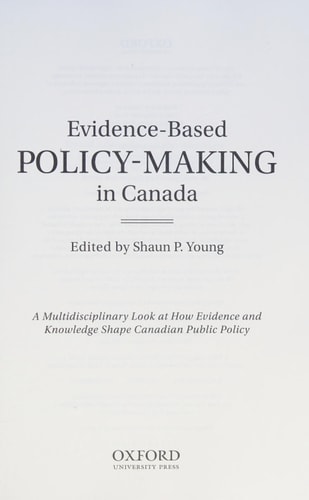
Making policy is what governments do, but there are some fascinating and hotly debated issues associated with how government decisions get made in the interests of the people. The concept and practice of evidence-based policy-making insists that properly developed public policy draws on the best available evidence. This book considers how governments in Canada have historically interacted with research and what directions these interactions may take in the future.The goal of government making decisions based on information collected in a scientific (or at least methodical and unbiased) manner goes back to the eighteenth-century Enlightenment. Given recent advances in the accumulation of such evidence, however, creating evidence-based policy has become an increasingly complex process. The ongoing generation of new knowledge continues to increase both the number and variety of potential policy issues and challenges. This process is often juxtaposed with "opinion-based" policy-making-a selective use of evidence or a reflection of the untested views of individuals or groups. In fact, the role of evidence in policy-making takes us to the very heart of the democratic process. Many victims of crime want longer prison sentences for criminals, but research shows that this is expensive and largely ineffective. To what extent should opinion be allowed to undermine the primacy of evidence? And other issues, such as the existing cultural and institutional challenges to evidence-based policy-making, are also considered across a range of disciplines.This collection considers these issues in the Canadian context, from the path knowledge travels via policy advisory systems and research-brokering organizations like the Fraser Institute, the CD Howe Institute, and the Canadian Centre for Policy Alternatives, to specific areas of policy including education, crime, tax, poverty, and environment. Contributors, leading scholars in their fields (a number of whom are also former senior civi
Menrva's Summary
THE THESIS
How can Canadian governance reconcile the objective requirements of evidence-based policy-making with the subjective pressures of democratic opinion and institutional constraints? Shaun P. Young compiles a collection of essays from leading scholars and former senior civil servants to examine the historical and contemporary relationship between research and government decision-making in Canada. The text evaluates the tension between methodical, data-driven policy and opinion-based approaches, analyzing how knowledge is brokered and implemented across various sectors of the Canadian state.
THE SCOPE MAP
What You Will Find
- Historical analysis of evidence-based policy origins dating back to the Enlightenment.
- Examination of policy advisory systems and research-brokering organizations like the Fraser Institute and the Canadian Centre for Policy Alternatives.
- Case studies across diverse policy domains including education, criminal justice, taxation, poverty reduction, and environmental regulation.
- Discussion of cultural and institutional barriers that impede the integration of scientific research into the legislative process.
THE AUTHORITY PERSPECTIVE
Experts identify this collection as a critical resource for understanding the mechanics of Canadian public administration and the challenges of knowledge translation in government. Readers frequently note the academic rigor of the contributors, making it a foundational text for students and practitioners of public policy.
Page Count:
240
Publication Date:
2014-06-24
Publisher:
Oxford University Press
ISBN-10:
0199003033
ISBN-13:
9780199003037
Canada
Public Administration
Sociology
Government
Public Policy
Community Tags
Similar Books