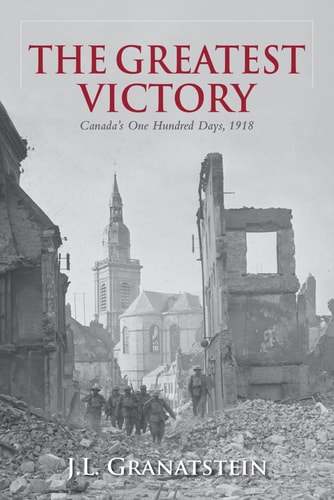
The Greatest Victory: Canada's One Hundred Days, 1918
0
0
As an Amazon Associate and affiliate partner, Menrva Books earns from qualifying purchases. Learn more
Author Description
The battle of Vimy Ridge in April 1917 is a much celebrated moment in both Canadian and European military history. Vimy was a costly success. While it did improve military and public morale, the reality is that it was more of a symbolic victory than a strategic one (the Germans retreated a few miles and many lives had been lost).Surprisingly, few Canadians are familiar with the real story of Canadian military success and sacrifice: the Hundred Days that led to the end of the war. Beginning on August 8, 1918, the Canadian Corps launched a series of attacks that took Amiens, crossed the Canal du Nord, smashed the Hindenburg Line, took Cambrai and Valenciennes, and defeated a quarter of the German Army in the field. On the morning of August 8, following the Canadian-led attack, German commander and joint head of the German army Erich Ludendorff called it "the Black Day of the German Army." In the hundred days that preceded the Armistice on November 11, 1918, the Canadian Corps made its greatest contribution to the Allied victory in World War 1 and, without question, the greatest contribution any Canadian force has ever made in battle. The 100,000 soldiers of the four Canadian divisions fought a mobile war that was revolutionary in its effectiveness and, as J. L. Granatstein argues, would influence the course of subsequent fighting, particularly in World War 2. With 45,000 casualties in three months (almost a quarter of Canadian casualties during the whole four years of the war), however, the costs were heavy.These Canadian-led assaults changed Allied fighting from static defensive positions to a war of mobility, technology, and smart coordination. How did Canadians come to lead these mobile, well-coordinated, and hard-hitting attacks? The preparations were intense, according to Granatstein, ranging from individual training to massive corps-wide exercises; careful analysis of "lessons learned" studies; expansion of the role of signallers, gunners and engineers; and perf
Menrva's Summary
THE THESIS
This work investigates how the Canadian Corps transitioned from static trench warfare to mobile, high-impact operations that proved decisive in the final months of World War I. J. L. Granatstein, a prominent military historian, utilizes archival records and operational reports to argue that the Hundred Days campaign represents the most significant military achievement in Canadian history. He examines the tactical evolution of the four Canadian divisions, detailing how their integration of technology, intelligence, and training methods fundamentally altered the trajectory of the conflict.
THE SCOPE MAP
What You Will Find
- Detailed analysis of the Hundred Days campaign from August to November 1918.
- Examination of tactical shifts including the use of signallers, engineers, and coordinated artillery.
- Strategic assessment of major engagements such as Amiens, the Canal du Nord, and the Hindenburg Line.
- Evaluation of the long-term influence of these mobile warfare tactics on subsequent military doctrine in World War II.
THE AUTHORITY PERSPECTIVE
Historians and military scholars frequently cite this text as a definitive account of Canada's operational effectiveness during the final stages of the Great War. The prose is noted for its clarity and reliance on primary source documentation, making it a standard reference for those studying the evolution of modern combat tactics.
Page Count:
304
Publication Date:
2014-09-11
Publisher:
Oxford University Press
ISBN-10:
0199009317
ISBN-13:
9780199009312
History
Canadian History
Military Science
Military History
Community Tags
Similar Books